
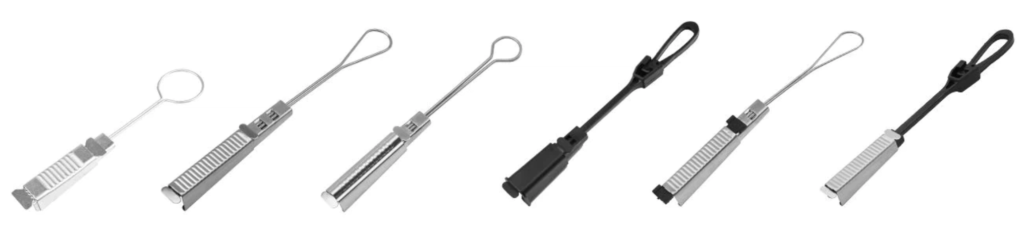
Introduce of Drop Wire Clamp
Request a quote today to ensure your FTTH or aerial deployment meets global reliability standards.
OptoLink offers the highest quality Drop Wire Clamp (DWC) solutions for use on FTTH aerial fiber deployment, aerial telecom lines, as well as low voltage service drop lines globally.
This webpage was created to assist Project Engineers, Distributors and Procurement Managers in determining an appropriate DWC solution by providing Product Introduction, Installation Instructions, and Frequently Asked Questions.
What Is a Drop Wire Clamp (DWC)?
To maintain the same orientation of the cable under wind, ice, and changes in temperature
A Drop Wire Clamp (DWC), commonly referred to as a Service Drop Clamp, Fiber Drop Clamp, or simply Drop Cable Clamp, is a self-locking mechanical device that is used to attach a drop cable to a telegraph pole, building, or other terminal point from an overhead main supply cable.
The following are primary functions of a Drop Wire Clamp for FTTH aerial fiber deployment:
To transfer tensile loads away from the cable core
To provide physical protection to the fiber or conductor’s insulation against mechanical strains during installation
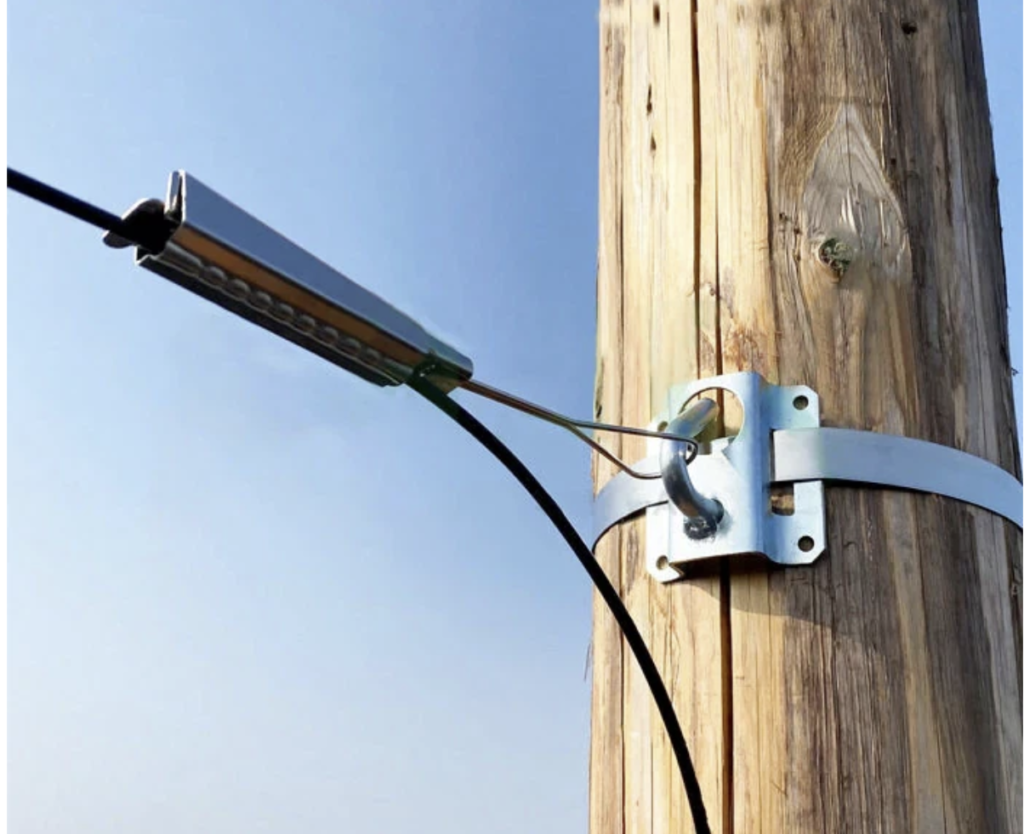
A Drop Wire Clamp (DWC), commonly referred to as a Service Drop Clamp, Fiber Drop Clamp, or simply Drop Cable Clamp, is a self-locking mechanical device that is used to attach a drop cable to a telegraph pole, building, or other terminal point from an overhead main supply cable.
The following are primary functions of a Drop Wire Clamp for FTTH aerial fiber deployment:
To transfer tensile loads away from the cable core
To provide physical protection to the fiber or conductor’s insulation against mechanical strains during installation
To maintain the same orientation of the cable under wind, ice, and changes in temperature
Typical Applications of Drop Wire Clamps
Drop Wire Clamps are widely used in:
FTTH deployments
Aerial telecommunications lines
Overhead connections
Service drop applications for low voltage lines
These applications require speed of installation and long-term reliability.
To properly install a Wedge-type DWC and ensure maximum service life, one must first understand the components that make up a Wedge-type Drop Wire Clamp
Components of a Wedge-Type Drop Wire Clamp
A standard Wedge-type Drop Wire Clamp manufactured by Unigreat includes the following:
Clamp Body (Shell)
Made from either Aluminum Alloy or 201/304 Stainless Steel, providing an excellent mechanical strength-to-weight ratio with high corrosion resistance for all outdoor applications.
Self-Locking Wedge
When tension on the cable increases, the wedge creates enough friction with the cable so that when the cable is under increased tension, a corresponding holding force is automatically created in the clamp and secures the cable in place.
Protective Gasket (optional)
The protective gasket is made from either plastic or rubber and is intended to protect the outer jacket of the fiber optic drop cable against damage due to mishandling during installation. This component is critical for applications utilizing FTTH aerial fiber deployment.
U-Shaped Pull Ring (Bail)
The U-shaped pull ring allows for the attachment of a drop wire clamp to pole brackets, cross arms, hooks, or wall anchors. As the weight of the cable is applied, the clamp automatically tightens itself and eliminates the need for bolts or other complex tools. This also provides secure anchoring of the attachment under dynamic loading conditions.
Applications of Unigreat Fibre Drop Wire Clamps
Broadband FTTH (fibre to the home) fibre drop cables
Telecommunications service drops from an overhead pole to a residential or commercial building
Low voltage overhead electrical service lines
Fastening temporary and permanent aerial drop cables in urban, rural, coastal, and high wind environments
Unigreat Fibre Drop Wire Clamps have seen significant acceptance and use by Telecommunications carriers, Utility Companies, Network Contractors, and Infrastructure Distributors.
This makes Unigreat a reliable OEM fiber drop clamp manufacturer for global projects.
Installation Instructions for a Drop Wire Clamp
For proper long-term stability and cable-to-cable protection, it is essential that a drop wire clamp for FTTH aerial fiber deployment is installed correctly.
Step 1: Prepare the clamp
With the wedge removed from the body of the clamp, check all components visually for distortion or damage.
Step 2: Place the cable in the clamp
The drop cable should fit snugly in the groove of the clamp. The groove must be sized to match the diameter of the cable. This ensures that the load from the cable will be transferred correctly from the cable to the clamp’s groove.
Step 3: Insert gasket and wedge (optional)
If using a gasket, position it between the outer jacket of the drop cable and the clamp body. The wedge should be positioned inline with the cable’s tension direction.
Step 4: Apply cable tension
Pull the cable gently until the wedge starts to grip. Be sure that not too much force is used to tighten it, as cable tension holds the cable in place, not manual tightness.
Step 5: Attach the clamp
Use the U-shaped pull ring to hang the clamp from a pole bracket, hook, or wall anchor.
Step 6: Final inspection
Ensure that the cable is straight and aligned, the wedge is fully seated, and the clamp is firmly mounted without any rotation. Keeping these items aligned reduces fatigue and increases the life of the cable over time.