
Fiber to the Home (FTTH) is a type of access technology where communication signals are sent from a central point directly to customers by fibre optic cables. In comparison with traditional access networks based on copper-based technology, FTTH offers a much higher level of bandwidth and data speed, as well as the capability to transmit data over much longer distances.
In addition, due to the growth of cloud computing, video streaming services, online gaming and smart home devices, the need for high-speed broadband access has increasing significantly. Thus FTTH has become the most widely-utilised technology around the globe for next generation broadband deployment
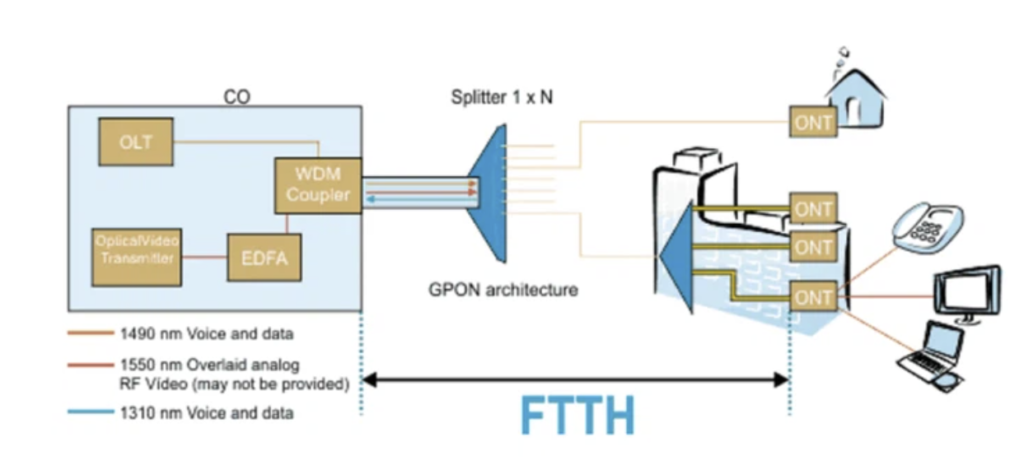
Fiber To The Home Architecture: PON and AON
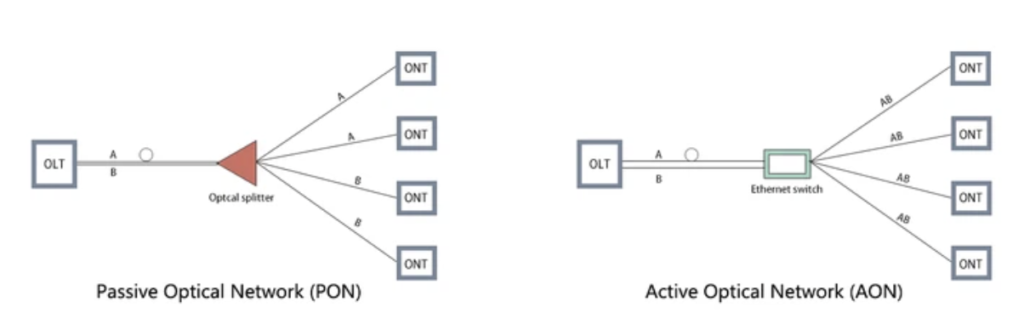
Two fibre optics architectures are used in FTTH networks today:
Passive Optical Network (PON)
Active Optical Network (AON)
The main difference between the two architectures is that PON networks transmit data using passive optical splitters, whereas AON networks use active electronics (such as Ethernet switches and routers) to amplify and manage the data signals. These two types of architecture exhibit a number of different characteristics, strengths, weaknesses and use cases.
Understanding Fibre Optics Technology
To understand FTTH networks better, you should first become familiar with fibre optics technology. Fibre optic technology uses light beams that travel down a fibre optic cable as the carrier medium for data transport. Optical fibres can be constructed from either glass or plastic, provide extremely low attenuation and provide high-capacity data transmission capabilities – making them the preferred medium for most modern communication networks.
Transmission Principle:
Optical fibres utilise total internal reflection as a transmission concept. Transmission of light through the fiber core continuously reflects light from one boundary to another, thus ensuring that signals can be transmitted over longer distances with minimal loss.
Fiber Types:
Single Mode Fiber (SMF) – Small core diameter (8–10 µm), operates in one propagation mode. Low attenuation and long-distance high-bandwidth transmission characteristics make this type of fiber very suitable for long distance applications.
Multi-Mode Fiber (MMF) – Larger core diameter (50 µm or 62.5 µm), supports multiple propagation modes due to modal dispersion. Multi-mode fiber is generally utilized for short-distance applications.
Signal Transmission and Reception:
Optical signals are transmitted and received using optical transmitters (laser diodes or light-emitting diodes) that convert electrical signals into optical signals. At the receiving end, optical signals are converted back into electrical signals using photodetectors.
Key Performance Measures:
Bandwidth – Maximum data rate supported by a fiber
Attenuation – Signal loss in dB/km
Latency – Time for a signal to travel from sender to receiver
Passive Optical Network (PON)
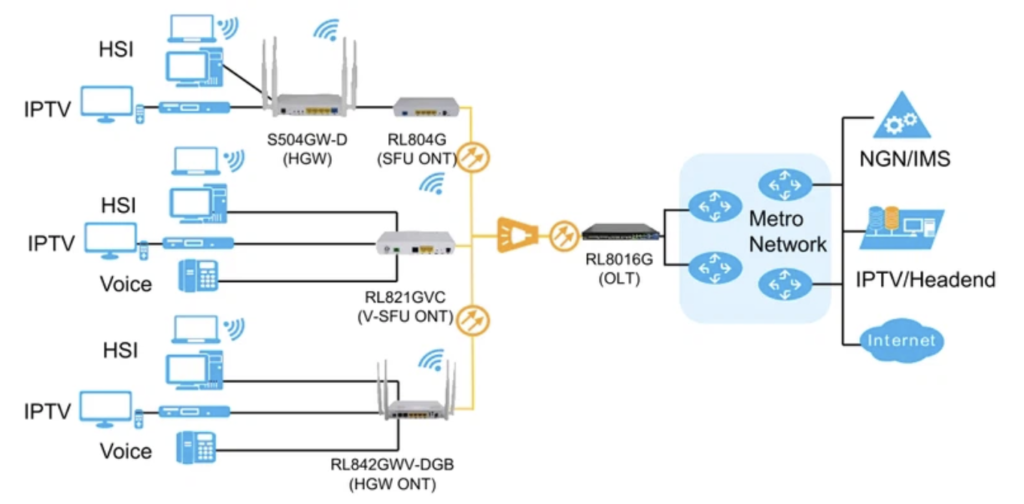
PON is a point-to-multipoint passive optical fiber access network that does not require electronic active devices between the provider and the end-users. In a standard PON configuration, the OLT (Optical Line Terminal) is positioned at the central office, and the OLT distributes the optical signal to multiple Optical Network Units (ONUs) or Optical Network Terminals (ONTs) via passive optical splitters.
How the PON System Works:
PON systems use Time-Division Multiple Access (TDMA):
Downstream: OLT broadcasts to all ONUs
Upstream: ONUs transmit in assigned time slots
This architecture provides optimal use of fiber with the least amount of physical plant.
Major PON Standards:
GPON (Gigabit-capable Passive Optical Network) – Defined by ITU-T and widely used
Downstream rate: 2.5 Gbps, Upstream rate: 1.25 Gbps
Excellent encapsulation efficiency with GEM
Advanced QoS for voice, video, and data services
Applications: Large residential communities, Multi-service broadband access networks
EPON (Ethernet Passive Optical Network) – Standardized by IEEE, Ethernet-based
Symmetrical upstream and downstream: 1.0 Gbps (10G-EPON optional)
Simple network management
Compatible with existing Ethernet networks
Applications: Urban and rural broadband, Cost-sensitive FTTH deployments
Active Optical Network (AON)
An AON provides a point-to-point fiber access architecture from a central switch/router to each end user via dedicated fiber, with exclusive bandwidth and flexible service control.
Generally includes Ethernet technology, easily integratable to existing LAN/WAN networks
Can be deployed as a standalone network without requiring a PON
Fiber Point-to-Point (P2P) Connection:
Central office connects directly to customer premise via fiber
Each customer has dedicated fiber, providing unique bandwidth and flexibility
Can use existing Ethernet infrastructure (DSL/FTTH)
Eliminates shared networks → highest bandwidth, redundancy, and resiliency
Fiber Hook-Ups in P2P:
Flat Patch Panel: Mounted within wall space, multiple fiber connectors
Angle Patch Panel: Mounted at entry point, flexible placement
Bright Patch Panel: Multiple light paths, enables multi-point access
Cross Connect: Interconnection between networks or locations providing access to a common network
Key Features:
Up to 10 Gbps dedicated bandwidth
Advanced QoS and traffic management
Easy integration with existing Ethernet infrastructure
Common Uses:
Enterprise broadband access
High-performance service applications
AON vs. PON Comparison
Network Architecture:
PON: Point-to-Multipoint via passive splitters
AON: Point-to-Point with active switching
Bandwidth:
PON shares bandwidth
AON provides dedicated bandwidth
Latency:
PON: low, using TDMA scheduling
AON: stable, unless an active device fails
Transmission Distance:
PON: ~20 km
AON: extended via active amplification
Cost and Maintenance:
PON: lower CAPEX and OPEX
AON: higher cost, but better performance
FTTH Network Design and Deployment
Network Design Includes:
Planning and topology selection
Equipment selection and capacity planning
Deployment, installation, and testing
Topologies: Star, Tree, Ring – each has trade-offs between cost and reliability
Testing: OTDR test performed for each fiber to ensure long-term stability
Conclusion
AON: Best for enterprises requiring high bandwidth, low latency, and dedicated service environments
PON: Best for large-scale residential FTTH deployments requiring cost-sensitive networks and simplified operations
For most urban FTTH deployments, PON is the most economical and scalable solution. AON is preferred for applications needing guaranteed bandwidth and advanced service control.