
n fiber optic cabling, there are two main types, which are single-mode fiber (SMF) and multimode fiber (MMF). Fiber cables operate by sending data by rolling light pulses. Single-mode and multimode fibers do differ in many engineering aspects, so knowing how these differences will impact cost, performance, and capability is essential for network designers, IT managers, and engineers who want to efficiently construct a truly economical network that will perform and be scalable for the future.
This guide outlines the fundamental differences in 2025 including the physical construction of the fibers, how far the data will travel, cost particulars and various standards of colors that are desired to assist in the selection process, among others.
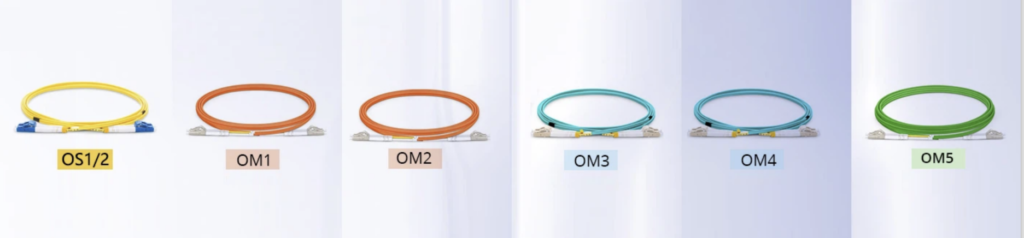
Core Differences Between Single-Mode and Multi-Mode Fibers
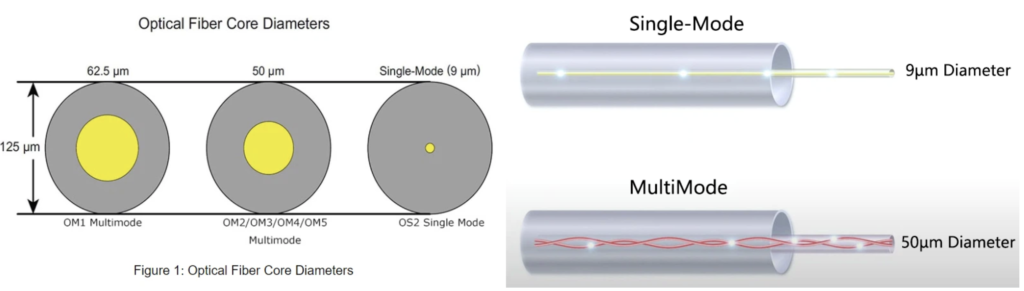
The different core diameter is the core difference between both types of fibers along with the method of propagation for the light roll through the fiber.
Single-Mode Fiber Core:
This has the small diameter of fiber core which is specified in microns (µm) and is generally 9µm in diameter. This allows but one mode of light to propagate through the core in a straight line down the core of the fiber, which causes no modal dispersion (a distortion of a signal) and therefore spectacular performance over long distances.
Multi-Mode Fiber Core:
This has a diameter core that is much larger (generally 50µm or 62.5µm) which allows several modes of light to propagate through the core simultaneously. This is economical as to short links, but since this will result in modal dispersion, that affects the bandwidths and longest distances that data can be transmitted.
Cladding Diameter:
Both formulations of single-mode and multi-mode bit have a standard fiber cladding diameter of 125µm.
Distance Capabilities of Single-Mode vs. Multimode Fiber
Distance capabilities are factors that separate fiber types and are important in making a selection.
Distance of Single-Mode Fiber:
Single-mode fiber supports long-haul transmissions and supports links of 10 meters and up to over 100 kilometers, up to 140 km with specific optics, with no signal regeneration. This makes it the evident choice for telecommunications, cable television networks, and campus backbones connecting distant buildings.
Distance of Multimode Fiber:
Optimized for short-distance applications. Depending upon the grade of fiber (OM3, OM4, OM5) and data rate, maximum distances are generally between 10 meters and 550 meters. For most data center and local area network (LAN) applications inside of buildings, multimode fiber has sufficient reach.
Cost Evaluation: Single-Mode vs. Multimode Fiber
A common myth is that multimode fiber is always the cheapest. A true cost analysis must be made on the total cost of the system.
| Cost Segment | Single-Mode Fiber | Multimode Fiber |
| Cable & Installation | More efficient manufacturing can make the cable itself cheaper. Installation can save 20-30% compared to MMF, and over 50% versus high-grade OM4/OM5. | The cable cost is often higher, especially for laser-optimized grades like OM4. Shorter distances may require more networking hardware. |
| Optical Transceivers | Transceivers (SFP, QSFP) are more expensive, costing 1.2 to 6 times more than MMF equivalents. This is due to the high-precision laser diodes required. | Significantly cheaper transceivers using LEDs or VCSELs (Vertical-Cavity Surface-Emitting Lasers). This is a major cost advantage for short-reach applications. |
| System Upgrade & Future-Proofing | Highly future-proof. Upgrading bandwidth (e.g., from 10G to 100G) typically only requires changing switches/transceivers, not the installed cable plant. | Upgrading beyond the cable’s bandwidth capacity (e.g., from OM3 to OM4) requires a complete and costly cable replacement. |
| Overall Summary | Lower total cost of ownership for medium to long distances. Best for future-proofing and scalability. | Lower total cost of ownership for short distances (e.g., within a data center or building). Cost-effective for defined, non-expanding needs. |
Single-Mode vs Multimode Fiber Color Code (TIA-598C Standard)
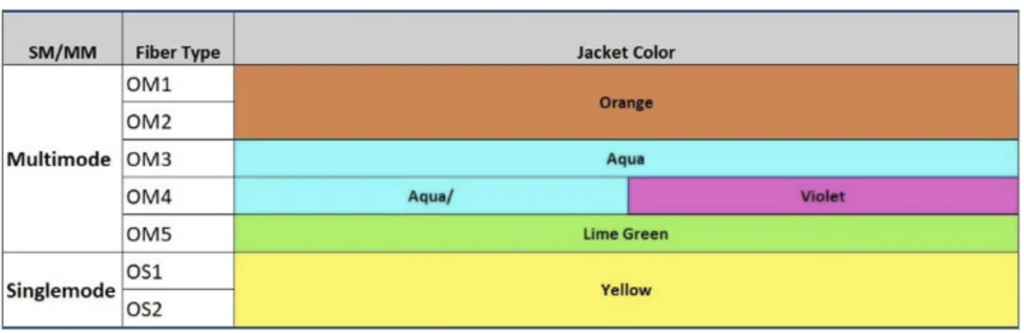
The jacket color provides immediate visual identification of the fiber type.
| Fiber Type | Jacket Color | Description |
| OM1 / OM2 | Orange | Standard multimode fiber for 1G and lower speeds. |
| OM3 / OM4 | Aqua | Laser-optimized 50µm multimode (LOMMF) for 10G, 40G, and 100G Ethernet. |
| OM5 (WBMMF) | Lime Green | Wideband Multimode Fiber, designed to support Shortwave Wavelength Division Multiplexing (SWDM). |
| OS2 (Single-Mode) | Yellow | Standard single-mode fiber for all long-distance and high-bandwidth applications. |
Note: OS1 is a tight-buffered cable mainly for indoor use, while OS2 is the standard loose-tube cable for outdoor/loose-tube applications. Both have yellow jackets.