

Introduction: Why APC Does Not Replace UPC as the Industry Standard
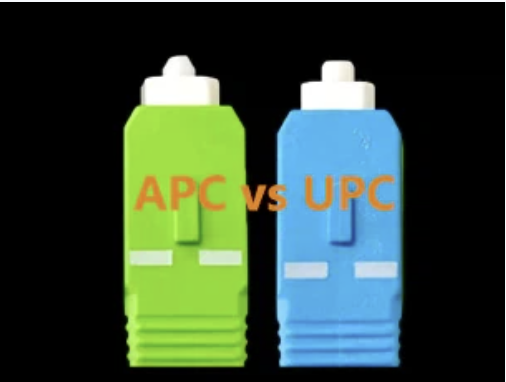
The APC (Angle Polished Connector) has been found to provide better return loss than the UPC (Ultra Polished Connector). Why aren’t all fiber optic connectors made with an APC?
The return loss of a fiber optic network is a critical parameter-especially in networks with signal reflections-the return loss specification is important for determining the quality of the transmission, or how much of the optical signal returns to the source, thereby potentially destabilizing the link.
An APC (Angle Polished Connector) has a typical return loss of greater than 60dB.
An UPC (Ultra Polished Connector) has a typical return loss of greater than 50dB.
It would be logical to expect, therefore, that since an APC offers better performance than an UPC; the industry would have adopted an APC connector as a standard. The reality, however, is that there is no single reason why APC does not dominate the market; instead, the selection of APC versus UPC depends on multiple factors, including application requirements (cost versus performance), the need for compatibility with existing equipment (legacy systems), and operational considerations.
The choice of components in fiber optic engineering is not merely to find the “best” component; rather, it is to choose the “right” component for the overall fiber optic system.
Basic Technical Differences Between APC and UPC Connectors
To further appreciate the differences between APC’s and UPC’s, one must first understand the basic technical differences between the two types of connector:
An UPC connector has a slightly convex (“curved”) polished end-face to reduce air gaps and Fresnel reflections; whereas,
An APC connector has an 8-degree angled polished end-face that directs returning light into the cladding instead of back towards the source laser.
The geometry created by the angled-end face of the APC connector allows for very low back reflection, and therefore makes APC connectors essential for use in optical systems that are sensitive to reflection
Application Scenarios Define the Actual Requirement (Most Important Consideration)
FTTH and PON Systems
Splitters in the PON area of a FTTH deployment cause significant downstream signal power reduction and allow multiple upstream signals onto the same fiber. Therefore, the smallest reflections can harm the upstream transmission, while also adding noise to the OLT.
This means the application of the APC connector is non-negotiable throughout the access network, from the OLT port to the ONU interface, as the APC connector will keep any reflections as low as possible
CATV (Cable Television) Systems
Also, due to their nature, analog signals are much more sensitive to reflections than digital signals. The quality of an analog signal is degraded by the introduction of nonlinear distortion elements caused by reflections.
As a result, the introduction of the following distortion elements is commonplace in CATV systems:
CSO (Composite Second Order)
CTB (Composite Third Beat)
All of the impairments stated above appear on the viewer’s end as: snow; ghosting; or image distortion. The use of APC connectors in these systems is non-optional and therefore, essential.
High-Speed Coherent Optical Transmissions
With the recent introduction of 100G, 400G, and beyond, coherent modulation formats require very high signal-to-noise ratios. Backreflection can have the effect of interacting with a laser source and local oscillator causing increased phase noise and degrading the system margin.
When minimizing these artifacts, APC connectors continue to be used more frequently in scenarios requiring critical reflection also.