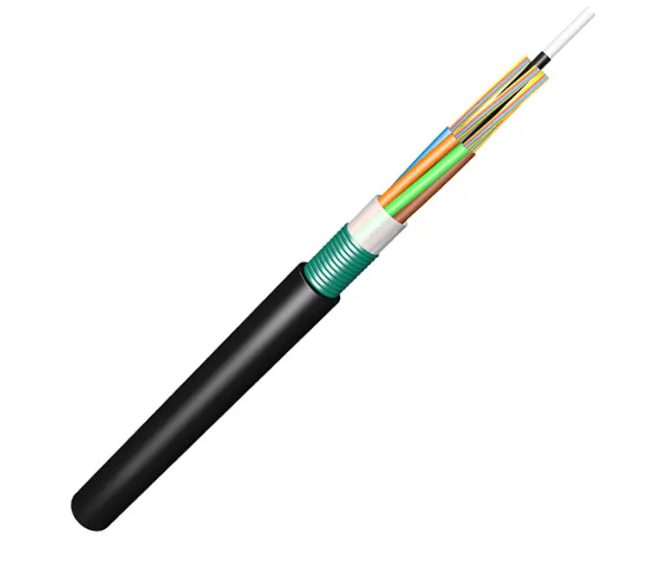
GYFS
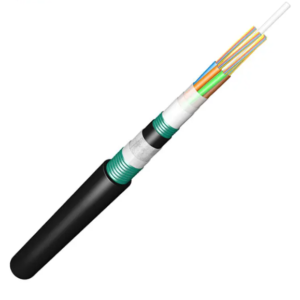
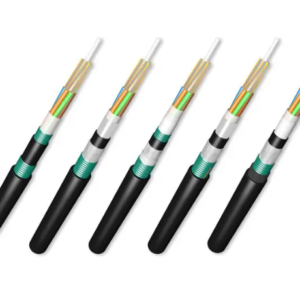
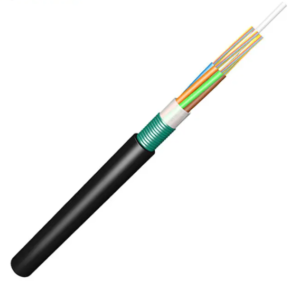
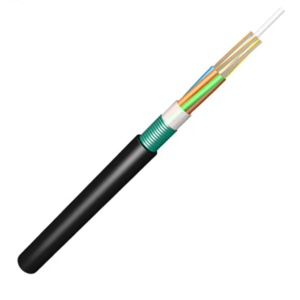
Optical Fiber Cable PSP Armored Stranded Loose Tube
Duct Installation
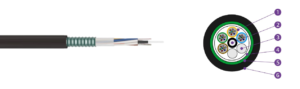
1. Loose Tube: thermoplastic material, containing opticalfibres and water blocking yarm.
2. Central Strength Mlember: glass fibre reinforced plasticrod (GFRP) coated with PE when needed.
3. Filler Elements: thermoplastic rods.
4. Longitudinal Water Blocking Material: Water blocking tape.
5. Armor: corrugated steel tape.
6. Outer Sheath: black polyethylene
■ Features and Applications:
Gel-free cable structure.
Easy for installation and splicing.
Duct installation and aerial installation.
■ Optical Characteristics:
Attenuation:
G.652.D Fiber:
1. @ 1310 nm: ≤ 0.36 dB/km
2. @ 1550 nm: ≤ 0.22 dB/km
3. Application: This fiber offers low attenuation at both 1310 nm and 1550 nm, making it ideal for long-distance communications.
G.655 Fiber:
1. @ 1310 nm: ≤ 0.40 dB/km
2. @ 1550 nm: ≤ 0.23 dB/km
3. Application: This fiber also provides excellent attenuation performance, although slightly higher than G.652.D at 1310 nm, making it suitable for applications with advanced dispersion management needs.
50/125 µm (Multimode):
1. @ 850 nm: ≤ 3.0 dB/km
2. @ 1300 nm: ≤ 1.0 dB/km
3. Application: Multimode fiber that operates at higher attenuation values but is commonly used for short-distance applications like within buildings or campuses.
62.5/125 µm (Multimode):
1. @ 850 nm: ≤ 3.0 dB/km
2. @ 1300 nm: ≤ 1.0 dB/km
3. Application: Similar to 50/125 µm multimode fiber, used for short-distance transmission with slightly larger core size.
Bandwidth:
50/125 µm (Multimode):
1. @ 850 nm: ≥ 500 MHz·km
2. @ 1300 nm: ≥ 1000 MHz·km
3. Application: Higher bandwidth at 850 nm and 1300 nm ensures that the fiber can support high-speed data transmission over relatively short distances.
62.5/125 µm (Multimode):
1. @ 850 nm: ≥ 200 MHz·km
2. @ 1300 nm: ≥ 600 MHz·km
3. Application: Slightly lower bandwidth than 50/125 µm, but still suitable for multimode applications with moderate data transmission needs.
Polarization Mode Dispersion (PMD):
G.652.D Fiber:
1. Individual fiber: ≤ 0.20 ps/√km
2. Design link value (M=20, Q=0.01%): ≤ 0.1 ps/√km
3. Application: Low PMD ensures minimal signal distortion, ideal for long-distance communication at high speeds.
G.655 Fiber:
1. Individual fiber: ≤ 0.20 ps/√km
2. Design link value (M=20, Q=0.01%): ≤ 0.1 ps/√km
3. Application: Similar to G.652.D, G.655 fiber also offers low PMD, ensuring high performance for long-distance and high-speed data transmission.
■ Technical Data:
Fiber Count and Tube Configuration:
Fiber Count Options:
o 24 fibers
o 48 fibers
o 72 fibers
o 96 fibers
o 144 fibers
o 288 fibers
Loose Tube Configuration:
o The number of tubes and fibers per tube increases with the fiber count:
§ 24 fibers: 2 x 12 fibers per tube
§ 48 fibers: 4 x 12 fibers per tube
§ 72 fibers: 6 x 12 fibers per tube
§ 96 fibers: 8 x 12 fibers per tube
§ 144 fibers: 12 x 12 fibers per tube
§ 288 fibers: 24 x 12 fibers per tube
Outer Diameter (mm):
o 24 fibers: 2.4 mm
o 48 fibers: 2.4 mm
o 72 fibers: 2.6 mm
o 96 fibers: 2.6 mm
o 144 fibers: 3.5 mm
o 288 fibers: 3.5 mm
Mechanical and Structural Properties:
Central Strength Member:
Material: GFPR (Glass Fiber Reinforced Plastic)
The central strength member provides structural strength, ensuring the cable can withstand mechanical stresses.
Diameter:
§ 24 fibers: 2.25 mm
§ 48 fibers: 2.25 mm
§ 72 fibers: 2.6 mm
§ 96 fibers: 2.6 mm
§ 144 fibers: 3.5 mm
§ 288 fibers: 3.5 mm
PE Coated Diameter:
§ 72 fibers: 4.2 mm
§ 144 fibers: 7.2 mm
§ 288 fibers: 4.8 mm
Outer Sheath:
o Thickness: Nominal 1.8 mm
o The outer sheath offers protection against environmental factors and mechanical damage.
Cable Dimensions and Weight:
Cable Diameter (Approx.):
o 24 fibers: 12.5 mm
o 48 fibers: 12.5 mm
o 72 fibers: 13.0 mm
o 96 fibers: 14.5 mm
o 144 fibers: 17.5 mm
o 288 fibers: 20.0 mm
Cable Weight (Approx.):
o 24 fibers: 130 kg/km
o 48 fibers: 130 kg/km
o 72 fibers: 140 kg/km
o 96 fibers: 175 kg/km
o 144 fibers: 255 kg/km
o 288 fibers: 320 kg/km
Operating and Mechanical Properties:
Operating Temperature Range:
o -40°C to +70°C
o The cable is suitable for use in extreme environmental conditions, both indoors and outdoors.
Tensile Strength:
o Short-term: 2700 N
o Long-term: 900 N
o The cable can withstand significant tension during installation (short-term) and operation (long-term).
Crush Resistance:
o Short-term: 1000 N/100 mm
o Long-term: 300 N/100 mm
o The cable offers good resistance to crushing forces, providing additional durability under heavy load or external pressure.
Additional Notes:
· The fiber and tube color arrangement is specified in a separate color identification table.
· Other fiber counts and cable structures are available upon request to meet specific customer requirements.