DESCRIPTION
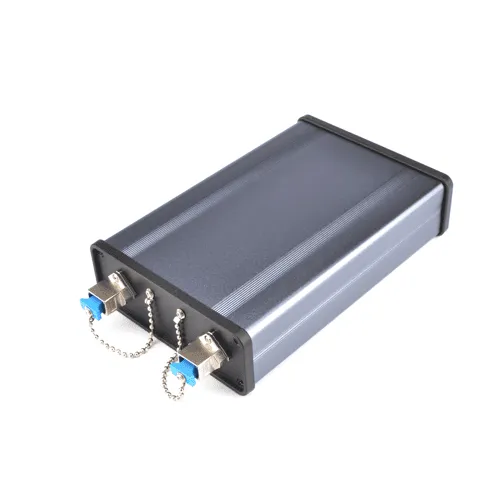
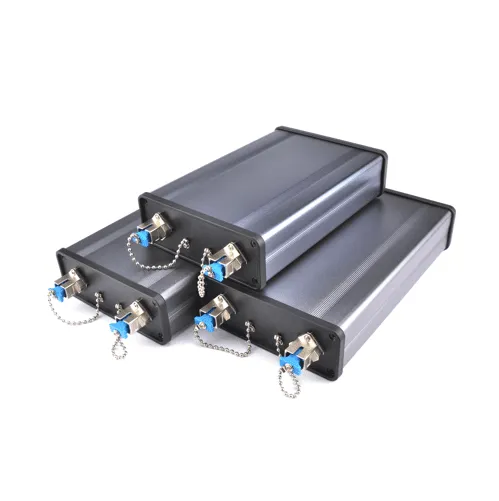
The HTO9O06 OTDR Launch Cable Box Aluminum Alloy Type is a compact and portable tool designed for OTDR testing, installation, and maintenance of fiber optic networks. Its aluminum alloy housing offers durability and lightweight portability, making it ideal for fieldwork. The device supports single-mode and multimode fibers with lengths up to 2,000 meters, minimizing measurement uncertainty caused by the OTDR’s launch pulse. With customizable connectors and a rugged design, this launch cable box is essential for precise and reliable network diagnostics.
Feature Details

- Compact and Durable Construction: Aluminum alloy housing ensures long-term durability and lightweight handling for easy transport.
- Flexible Fiber Lengths: Available in configurations supporting up to 2,000 meters of fiber, with no internal splicing for consistent performance.
- Customizable Connectors: Input and output connectors include options like FC, SC, ST, LC, and APC variations to suit diverse testing needs.
- Low Loss Design: Typical insertion loss of < 1 dB @ 1310 nm for 1,000 meters, ensuring accurate testing results.
- Wide Temperature Range: Operates reliably in harsh environments, with a temperature range of -40°C to +55°C.
Product Specifications
| Dimensions (mm) | 140(L) x 96(W) x 33(D) (Max: 0.5 km) 170(L) x 96(W) x 33(D) (Max: 1.0 km) 190(L) x 96(W) x 33(D) (Max: 2.0 km) |
| Weight | 0.25-0.35 kg (without fiber) |
| Material | Aluminum Alloy |
| Color | Silver (with black edges) |
| Typical Loss | < 1 dB @ 1310 nm for 1,000 meters |
| Operating Temperature | -40°C to +55°C |
| Fiber Types | Corning G652D, Corning G657A, Corning 50/125 MM, 62.5/125 MM, OM3 |
| Input Adaptor/Connector | FC, SC, ST, FCA, SCA, LC, LCA |
| Output Adaptor/Connector | FC, SC, ST, FCA, SCA, LC, LCA |
| Maximum Fiber Length | 2,000 meters |
| Applications | Pulse suppressor, delay line, installation/testing, training, calibration |
| Customizable Options | Adaptors, patch cords, and connector types on request |
NOTE: Other special fiber or connectors are available upon request.
Selection Notes
- Typically selected when OTDR acceptance or troubleshooting needs a reliable launch/delay section to measure the first/last connectors more consistently, and the team benefits from a rugged aluminum housing for frequent field transport.
- May not be appropriate for deployments where crews cannot standardize the connector interface (including APC variants) and launch length across sites, since inconsistent configurations can reduce repeatability and increase retesting during installation or maintenance.
Application Details

- Field Testing: Lightweight and compact design ensures easy handling for OTDR testing in the field.
- Network Installation: Verifies fiber optic connections during deployment, ensuring performance reliability.
- Optical Network Calibration: Enables accurate reflection and loss measurements across all fiber lengths.
- Maintenance Operations: Supports regular diagnostics and troubleshooting for optical communication networks.
- Customizable Solutions: Adaptable to different connectors and fiber types for specific testing needs
FAQ
Q1: What is the purpose of an OTDR fiber launch cable box?
It is used to eliminate the launch dead zone and receive dead zone during OTDR testing. This allows accurate measurement of the first and last fiber connectors.
Q2: Why use an aluminum alloy shell?
The aluminum alloy shell provides strong mechanical protection and durability. It is suitable for field testing environments where impact resistance is required.
Q3: What fiber types are supported?
Single-mode fiber is typically used, with optional multimode versions available. Connector types can be selected based on OTDR interface requirements.
Q4: What cable lengths are commonly available?
Common lengths include 500 m, 1 km, or longer upon request. The appropriate length depends on OTDR resolution and testing standards.
Q5: Is this launch cable box portable for field work?
Yes, the compact design and sturdy enclosure make it easy to transport for on-site testing. It is suitable for both indoor and outdoor test scenarios.
Q6: Typical applications?
Used in FTTH installation, telecom maintenance, data center fiber testing, and acceptance testing with OTDR equipment.