
Commonalities and Standard Origin of G.657.A2, G657.A1 and G.652.D
Technical Breakdown: Comparison of Technical Parameters (Accurate Distinction)
- 1. Bending Performance: The Dividing Line Among G.652D, G.657A1 and G.657A2
- 2. Application Scenarios: Differentiated Positioning for Global Deployment
- 3. Cost and Compatibility: Important References for Selection
- Selection Suggestions: On-Demand Matching, Avoid Over-Selection
- Introduction to Corresponding Products on Op2Link
- 1. G.652D Single-Mode Fiber
- 2. G.657A1 Single-Mode Fiber
- 3. G.657A2 Single-Mode Fiber
- Summary
- Q&A
- For long-distance transmission (over 50km), should I choose G.652D or the G.657 series?
- Can G.657A1 and G.657A2 be laid in a hybrid manner?
- Can Op2Link’s G.652D, G.657A1 and G.657A2 fiber products be directly connected to existing G.652D networks?
- With a limited budget, which one is more suitable for FTTH drop cables?
- Which type should be used for data center wiring?
- Why is G.657A2 recommended for fiber optic drones?
In the deployment of global optical fiber communication networks, single-mode fiber has become the core carrier for backbone networks, metropolitan area networks, access networks, and data center interconnections due to its advantages of low loss, high bandwidth, and long transmission distance. Among them, G.652D, G.657A1, and G.657A2 are the three most widely used types of Single-mode Fiber. Although they all fall into the single-mode category, there are significant differences in technical parameters, bending performance, and application scenarios, which often confuse engineering technicians during model selection. From a technical perspective, this article comprehensively breaks down the core differences among the three, provides selection suggestions combined with global application scenarios, and introduces corresponding compatible products on Fibermart to help practitioners select models accurately and deploy efficiently.
Commonalities and Standard Origin of G.657.A2, G657.A1 and G.652.D
First, clarify a key premise: G.652D, G.657A1, and G.657A2 all comply with the single-mode fiber standards formulated by the ITU-T (International Telecommunication Union Telecommunication Standardization Sector). All are zero water peak fibers (which can eliminate the water absorption peak near the 1383nm wavelength) and support full-band transmission at 1310nm and 1550nm. In addition, G.657A1 and G.657A2 are fully compatible with G.652D fiber and can be seamlessly connected to existing G.652D fiber networks without additional equipment modification, which is the core foundation for the hybrid deployment of the three worldwide.
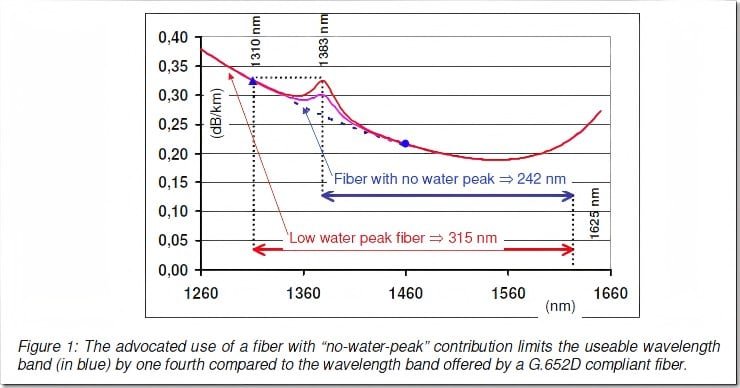
The core differences among the three are essentially designed to adapt to different laying environments and transmission requirements. The most critical differences are concentrated in bending loss characteristics, minimum bending radius, and the resulting differences in applicable scenarios — which are also the core judgment basis for engineering selection.
Technical Breakdown: Comparison of Technical Parameters (Accurate Distinction)
For an intuitive distinction, here is a core parameter comparison table (data refers to the latest ITU-T standards and measured values of mainstream global products), followed by a detailed interpretation of key differences:
| Parameter Index | G.652D | G.657A1 | G.657A2 |
|---|---|---|---|
| Fiber Type | Standard single-mode fiber (non-bend-insensitive) | Bend-insensitive single-mode fiber (Class A) | Bend-insensitive single-mode fiber (Class A) |
| Minimum Bending Radius (Static/Dynamic) | 30mm/60mm (standard value) | 7.5mm/15mm | 5mm/10mm |
| Transmission Loss (1310nm) | ≤0.34dB/km | ≤0.34dB/km | ≤0.34dB/km |
| Transmission Loss (1550nm) | ≤0.20dB/km | ≤0.20dB/km | ≤0.23dB/km (some products can be as low as 0.20dB/km) |
| Mode Field Diameter (1310nm) | 8.6~9.5μm (±0.4μm) | 8.6~9.5μm (±0.4μm) | 6.3~9.5μm (±0.4μm) |
| Compatibility | Compatible with all single-mode fibers, the most widely deployed worldwide | Fully compatible with G.652D, hybrid deployment available | Fully compatible with G.652D, hybrid deployment available |
| Core Advantages | Low loss, high compatibility, cost-effective, mature technology | Low bending loss, easy installation, suitable for narrow spaces | Optimal bending performance, strong adaptability to high-density wiring |
Interpretation of Key Differences:
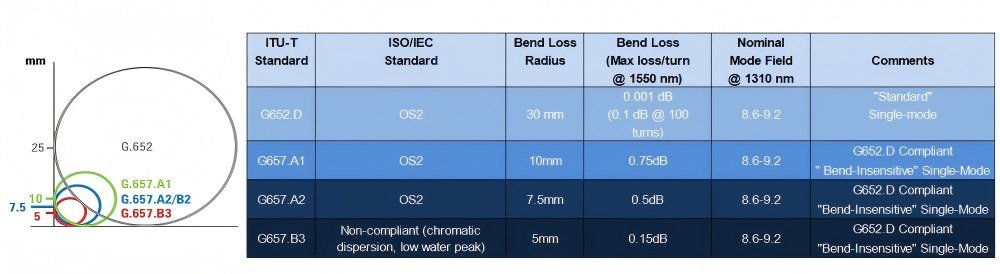
1. Bending Performance: The Dividing Line Among G.652D, G.657A1 and G.657A2
This is the most intuitive difference and the core distinction between the G.657 series and G.652D. As a standard single-mode fiber, G.652D has weak bending performance. Excessive bending (e.g., radius less than 30mm) during laying will cause a sharp increase in signal attenuation or even fiber breakage, making it more suitable for straight-path laying. In contrast, G.657A1 and G.657A2, as bend-insensitive fibers, greatly reduce bending loss by optimizing the core and cladding structure. Among them, G.657A2 has the best bending performance with a minimum static bending radius of only 5mm. It can easily bypass wall corners and pipe bends, and even be densely wound in cabinets without signal loss concerns.
A common misconception needs to be corrected here: many people believe that bend-insensitive fibers have higher transmission loss than G.652D. In fact, the loss of the three is basically the same in the mainstream 1310nm and 1550nm bands. The loss advantage of the G.657 series only stands out in extreme bending scenarios — which is the core reason why it can replace G.652D for indoor and narrow-space laying.
2. Application Scenarios: Differentiated Positioning for Global Deployment
Combined with the deployment characteristics of global communication networks, the applicable scenarios of the three are clearly divided, non-overlapping and complementary, as detailed below:
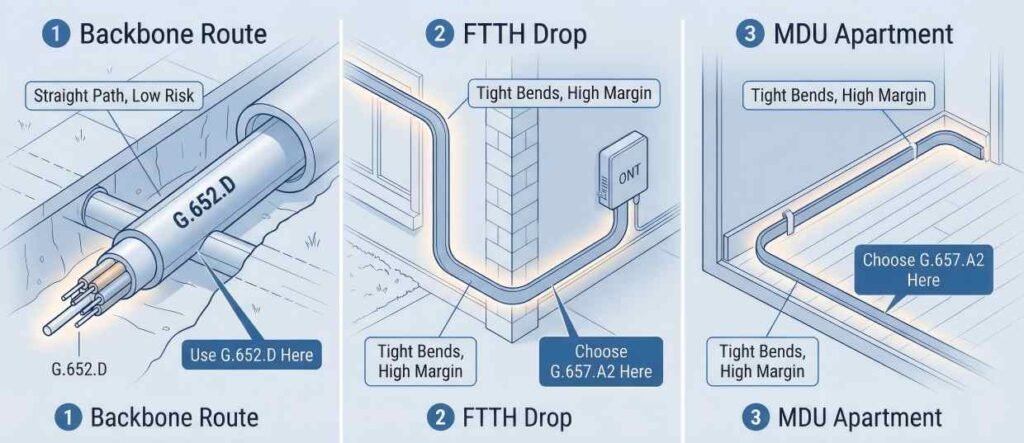
(1) G.652D: The mainstay of global backbone and metropolitan area networks. Due to its low loss, long transmission distance (unrepeatered transmission over 100km), cost-effectiveness and mature technology, G.652D is currently used in most long-distance backbone networks and intercity metropolitan area networks worldwide. It can also be applied to the backbone sections of access networks for outdoor pipeline and aerial laying. In addition, amid the rebound in global fiber prices in 2025, G.652D faced supply shortages as production capacity shifted to high-end products, further highlighting its core position in global network infrastructure.
(2) G.657A1: The preferred solution for FTTH (Fiber to the Home). With the accelerated global deployment of FTTH, indoor wiring, corridor junction boxes, and user terminal access have raised higher requirements for fiber bending performance. With a minimum static bending radius of 7.5mm, G.657A1 can easily adapt to indoor concealed wiring, wall corner bending and other scenarios. Meanwhile, it is compatible with G.652D and can be seamlessly connected to outdoor backbone networks, being widely used in residential and commercial building FTTH projects in Europe, North America and other regions.
(3) G.657A2: The dedicated fiber for high-density wiring scenarios. In recent years, the global demand for data centers and server rooms has surged. Such scenarios require high-density wiring in narrow spaces, and the advantage of G.657A2’s 5mm minimum static bending radius is fully highlighted. It can be densely wound on cabinet backplanes and wiring ducts with extremely low microbending additional loss, and supports high-speed transmission of 40G/100G and above, making it the preferred fiber for global data center interconnection and indoor high-density wiring. Since 2025, the global demand for G.657A2 has increased significantly, becoming one of the core drivers of growth in the fiber market.
3. Cost and Compatibility: Important References for Selection
In terms of compatibility, the three are fully interoperable without signal interference in hybrid deployment, which facilitates the upgrading and transformation of global networks — for example, existing G.652D backbone networks can be directly connected to G.657A1/A2 indoor branches without equipment replacement.
In terms of cost, the three have a clear price gradient: G.652D is the cheapest (most mature production technology and largest global production capacity), followed by G.657A1, and G.657A2 is the most expensive (optimized bending performance leads to more complex production processes, with a drawing efficiency 10-15% lower than G.652D). Since 2025, global fiber prices have rebounded overall, with the price of bare G.652D fiber rising by more than 450% and G.657A2 surging by 557%. The price advantage of high-end products has become more prominent, also driving the shift of global fiber production capacity to high-end products such as G.657A2.
Selection Suggestions: On-Demand Matching, Avoid Over-Selection
Combined with the deployment needs of different global scenarios, 3 precise selection suggestions are provided to avoid unnecessary cost waste:
● For global long-distance backbone networks, intercity metropolitan area networks, and outdoor long-distance pipeline/aerial laying, prioritize G.652D, which balances low loss, long distance and economy and is compatible with most mainstream transmission systems;
● For FTTH drop cables, indoor wiring of residential/commercial buildings, and corridor distribution, prioritize G.657A1, which balances bending performance and cost and meets the construction needs of most global FTTH projects;
● For data centers, server rooms, high-density cabinet wiring, or laying in extremely narrow spaces, prioritize G.657A2. Its excellent bending performance can greatly reduce construction difficulty, ensure the stability of high-speed transmission, and adapt to the upgrading needs of global data centers.
Introduction to Corresponding Products on Fibermart
As a world-renowned supplier of optical fiber communication products, Fibermart covers a full range of single-mode fiber products including G.652D, G.657A1 and G.657A2. All products comply with ITU-T standards, adapt to the deployment needs of different global scenarios, and have stable supply capacity to cope with the current global fiber supply shortage. This series of products have passed strict quality inspections, featuring tensile resistance, compression resistance, moisture resistance and a service life of more than 30 years. They can meet the engineering construction standards of different regions worldwide and provide reliable support for the stable operation of communication networks.
1. G.652D Single-Mode Fiber
Op2Link’s G.652D single-mode fiber, with the model number FM-SMF-G652D-9/125, adopts a high-purity quartz core and strictly complies with the ITU-T G.652D standard. It supports full-band transmission at 1310nm/1550nm with a loss as low as 0.20dB/km in the 1550nm band. It is perfectly suitable for the long-distance transmission needs of global backbone and metropolitan area networks, and can also be used for the backbone sections of access networks for outdoor pipeline and aerial laying. Balancing low loss, economy and high compatibility, it is the preferred product for global long-distance communication networks.
2. G.657A1 Single-Mode Fiber
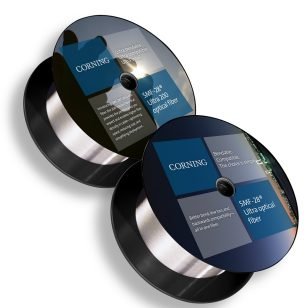
The G.657A1 single-mode fiber with the model number FM-BI-SMF-G657A1-9/125 features bend insensitivity, with a minimum static bending radius of only 7.5mm and a dynamic bending radius of 15mm. It can flexibly adapt to narrow-space scenarios such as FTTH drop cables, indoor wiring of residential and commercial buildings, and corridor distribution. This product is seamlessly compatible with G.652D fiber and can be directly connected to outdoor backbone networks without additional equipment modification, being widely suitable for the construction needs of FTTH projects in Europe, North America and other regions.
3. G.657A2 Single-Mode Fiber
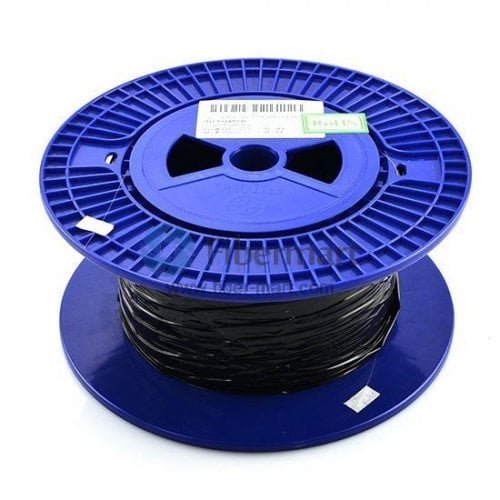
The G.657A2 single-mode fiber focusing on high-density wiring scenarios has the model number FM-BI-SMF-G657A2-9/125, with a minimum static bending radius as low as 5mm and a dynamic bending radius of 10mm. It has extremely low microbending additional loss and can be densely wound on cabinet backplanes and wiring ducts without affecting signal transmission. This product supports high-speed transmission of 40G/100G and above, making it an exclusive preferred choice for high-density wiring scenarios such as global data centers and server rooms, and can meet the high-speed and stable transmission needs of data center interconnection.
Summary
G.652D focuses on “long distance, low cost and high compatibility”, suitable for global backbone networks and outdoor long-distance deployment; G.657A1 focuses on “easy installation, medium cost and bend insensitivity”, suitable for global FTTH drop scenarios; G.657A2 focuses on “high bend resistance, high adaptability and high speed”, suitable for high-density wiring scenarios such as global data centers. The three are compatible and interoperable, and the core of selection is “matching the laying environment and transmission needs” without blindly pursuing high-end models.
If you have questions about global fiber deployment or product selection, follow our subsequent shares or leave a message to communicate specific scenarios, and we will provide you with a more accurate selection solution.
Q&A
For long-distance transmission (over 50km), should I choose G.652D or the G.657 series?
Prioritize G.652D. Its low loss is more suitable for long distances with a more economical cost.
Can G.657A1 and G.657A2 be laid in a hybrid manner?
Yes. Both are compatible with G.652D and each other, and can be matched on demand.
Can Op2Link’s G.652D, G.657A1 and G.657A2 fiber products be directly connected to existing G.652D networks?
Yes. All comply with ITU-T standards and are seamlessly compatible with existing G.652D networks without equipment modification.
With a limited budget, which one is more suitable for FTTH drop cables?
Choose G.657A1. It balances bending performance and cost to meet the needs of drop wiring.
Which type should be used for data center wiring?
Prioritize G.657A2. The core demands of data center wiring are high density and high speed. It has a minimum static bending radius of only 5mm and extremely low microbending additional loss, adapting to dense winding wiring in cabinets and supporting 40G/100G and above high-speed transmission; G.657A1 has insufficient bending performance, and G.652D is not suitable for bending in narrow spaces, so neither is recommended.
Why is G.657A2 recommended for fiber optic drones?
The core reason is that drone wiring often traverses complex terrains (such as mountains and forests, buildings), and the fiber is prone to bending and dragging. G.657A2 has the best bending performance (minimum static bending radius of 5mm) and extremely low microbending additional loss, which can avoid signal attenuation caused by bending; meanwhile, it supports 40G/100G high-speed transmission, adapting to the high-speed signal transmission needs of drone wiring, ensuring stable signals during the wiring process and suitable for complex outdoor laying scenarios.