DESCRIPTION
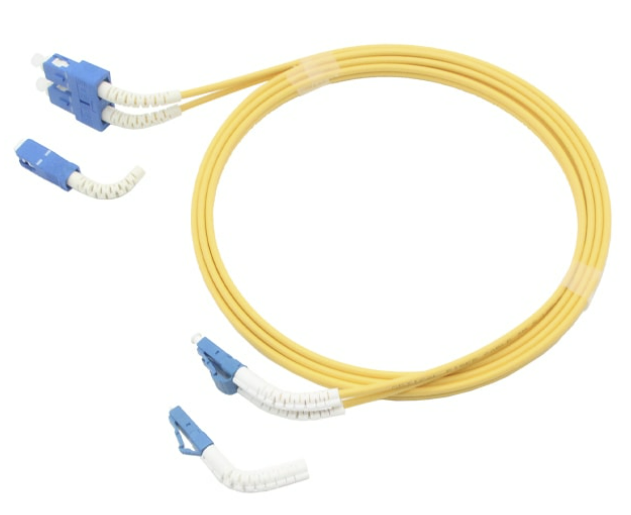
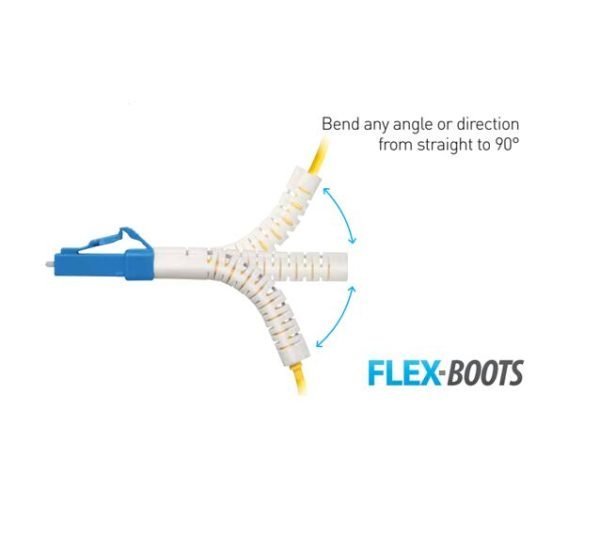
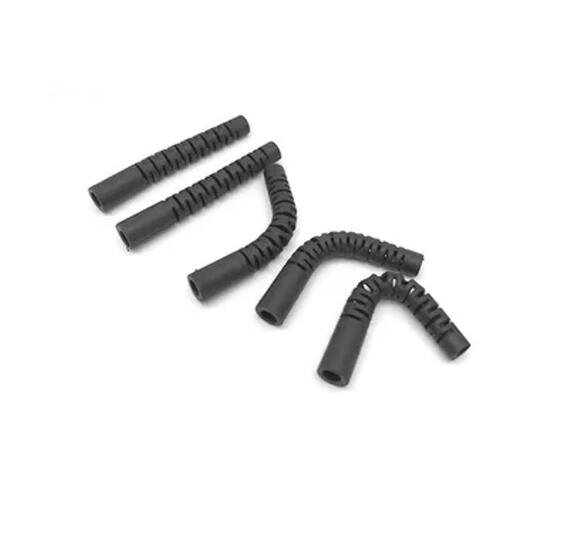
Flex Angle boots for LC fiber optic connectors are now available for single-mode and multimode patch cords. These boots are designed for easy pre-bending in any direction or angle by the installer to ensure optimal network performance by maintaining their position.
They can also be reshaped or straightened for connector disconnect. These fiber optic patch cords with LC flex boots are particularly suited for unique applications like high-density environments or tight constraint areas, ensuring perfect connector installation. Additional fiber bend protection is provided by the LC flex boots, making them ideal for cable management purposes.
OP2Link also provides a full set of OEM services, such as fiber connector, length, color, fiber grade, specification, material, package etc.
Feature Details

- Flex-Angle Boot Technology:
- Allows installers to bend the boot into any direction or angle, making it suitable for unique or challenging installations.
- Superior Durability and Safety:
- Flame-retardant, rugged cable jacket ensures long-term reliability even in demanding environments.
- High Compatibility:
- Supports a wide range of fiber types, including SM: G652D, G657A1/A2/B2/B3, and MM: OM1-OM5.
- Available in 2.0mm and 3.0mm cable diameters.
- Excellent Optical Performance:
- Insertion loss as low as ≤0.12dB (Grade B) and return loss ≥60dB for SM APC connectors.
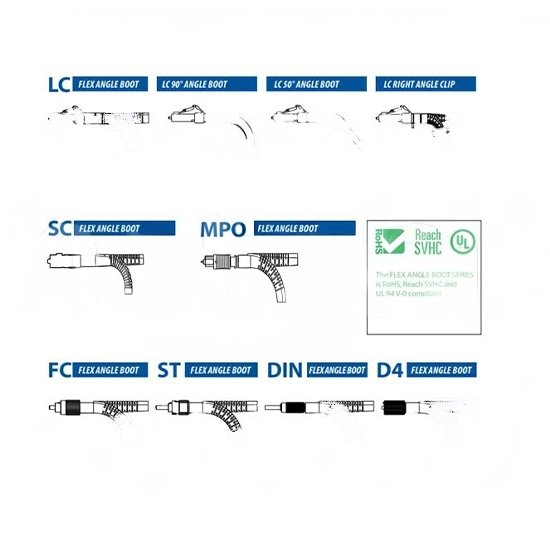
| Connector Type | LC & SC with Flex Angle Boot |
| Fiber Mode | Single Mode (SM) & Multimode (MM) |
| Polish Type | UPC/APC for SM, PC for MM |
| Insertion Loss | ≤0.3dB (Grade C), ≤0.12dB (Grade B) |
| Return Loss | UPC ≥50dB, APC ≥60dB, MM PC ≥35dB |
| Cable Diameter | 2.0mm & 3.0mm |
| Jacket Material | PVC (OFNR), LSZH, Plenum (OFNP) |
| Operating Temperature | -40°C to +85°C |
| Durability | 500 Mating Cycles |
Selection Notes
Typically selected when patch cords must be routed in high-density racks, ODFs, or confined spaces where straight or fixed-angle boots create excessive bend stress or obstruct adjacent ports.
May not be appropriate for standard open installations or low-density cabinets where conventional straight boots already provide sufficient bend radius and strain relief.

- High-Density Environments: Allows for neat and organized cabling in racks and ODFs.
- Telecommunication Equipment: Compatible with standard and high-performance transceivers (e.g., SFP, SFP+, XFP).
- Constrained Installations: Ideal for tight spaces where traditional cables may struggle.
- Custom Solutions: Tailored to match specific network requirements for both enterprise and telecom applications.
- Customization Options:
- Available in a range of fiber types, diameters, and jacket materials to meet diverse needs.
- Comes with various connector styles, including standard, uniboot, and short boot configurations.
- Compliance with Standards:
- Fully certified to meet international safety, performance, and environmental guidelines (RoHS, ISO9001).
FAQ
Q1: What is the advantage of flex angle boot patch cables compared to standard patch cords?
Pre-bendable to multiple directions for routing in high-density areas (installer adjustable). Making it ideal for high-density panels and tight spaces where standard straight boots are difficult to manage.
Q2: What is the difference between LC and SC flex angle boot connectors?
LC connectors are smaller form factor, ideal for high-density applications, while SC connectors are larger and widely used in telecom and FTTH systems. Both types are available with UPC or APC polish.
Q3: Are flex angle boot cables suitable for both single-mode and multimode fibers?
Yes. They are available in OS2 single-mode for long-distance links, as well as OM3/OM4/OM5 multimode options for short-distance, high-speed connections.
Q4: How do I choose the correct boot angle direction?
The boot can be adjusted during installation to bend left, right, up, or down. This flexibility reduces cable stress and makes routing easier in confined spaces.
Q5: What jacket materials are available for flex angle boot patch cords?
Options include LSZH for indoor safety, PVC for general use, and OFNR/OFNP for riser or plenum environments. Selection depends on building codes and installation conditions.
Q6: How are flex angle boot patch cords tested before shipment?
Each cable undergoes 100% factory testing for insertion loss (<0.3 dB typical) and return loss, ensuring compliance with IEC and Telcordia standards.
Q7: Can these cables be customized in length and color?
Yes. Customers can specify length, fiber type, connector type, jacket color, labeling, and packaging to match their project needs.
Q8: Where are LC & SC flex angle boot patch cords typically used?
They are widely used in data centers, telecom cabinets, FTTH deployments, and enterprise IT networks where space-saving and reliable connections are critical.