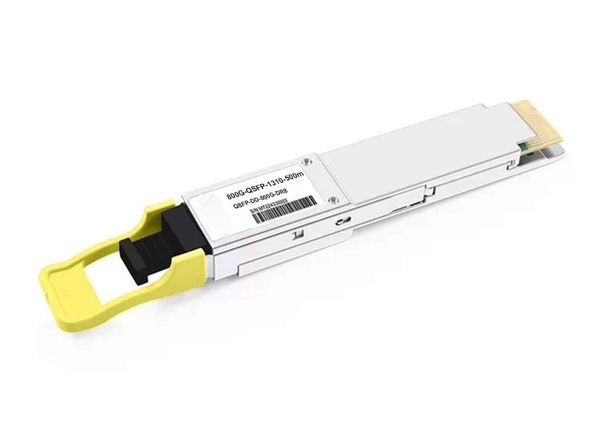
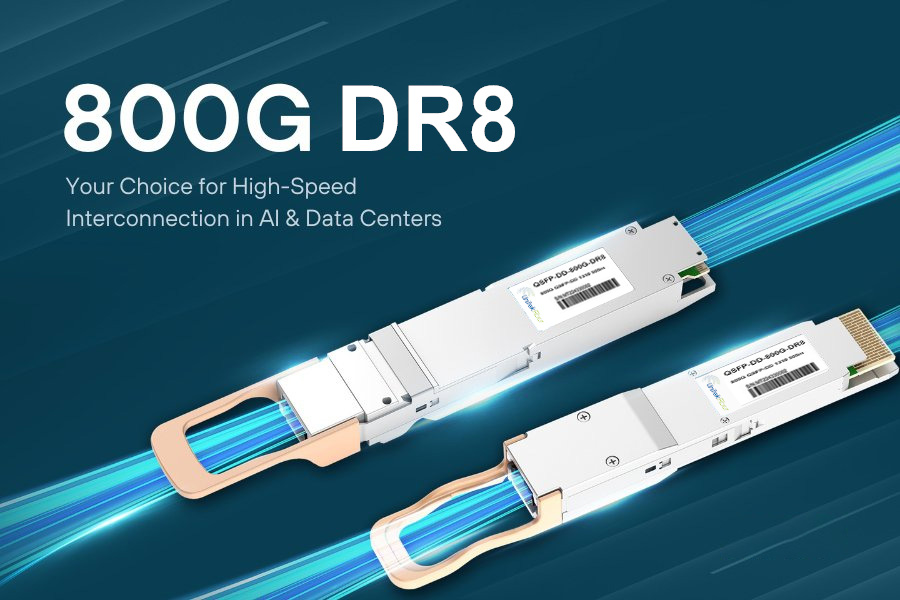
800G QSFP-DD SR8 Optical Transceiver: High-Density AI Cluster Interconnect
The 800G QSFP-DD SR8 (Short Reach 8-channel) is a pluggable optical transceiver designed for 800Gbps Ethernet links over multimode fiber (MMF). Operating at 850nm with 8 lanes of 112G PAM4 signaling, it supports distances up to 60m (OM3) or 100m (OM4/OM5). Utilizing the QSFP-DD (Double Density) form factor and a MPO-16/MTP-16 connector, this module is the ideal solution for Top-of-Rack (ToR) and Leaf-Spine interconnects in next-generation AI data centers and hyperscale cloud environments.
As GPU clusters expand, selecting specialized 800G AI infrastructure connectivity solutions has become critical for maintaining zero-packet-loss fabrics in modern high-performance computing environments.
Core Advantages and Features of 800G QSFP-DD Transceiver Module
Offering an aggregate data rate of 800Gbps, the 800G transceiver enables the rapid transmission of large volumes of data. This high bandwidth is achieved through a combination of multiple channels and advanced modulation formats, making it suitable for applications with demanding data transfer requirements, such as high-performance computing, data center interconnects, and cloud computing. 800G QSFP-DD form factor provides several advantages. This 800G fiber transceiver is hot-pluggable, allowing for easy installation and replacement without disrupting network operations. Additionally, its small size enables high port density in networking equipment, optimizing space utilization within data centers where space is often at a premium. Equipped with dual MPO-12 connectors, the 800G transceiver module is designed for use with single-mode fiber (SMF), supporting high-density fiber optic deployments, reducing cable clutter and simplifying cable management. Typically operates within a temperature range of 0°C to 70°C, allowing for reliable performance in various environmental conditions commonly found in data centers and other network installations.
The shift toward Terabit networking highlights the role of 800G high-speed communication as the backbone for low-latency data exchange in next-generation cloud architectures.
800G QSFP-DD DR4 Transceiver Module: Revolutionizing Network Performance
The high data rate and efficient modulation of the 800G QSFP-DD DR4 transceive module significantly improve network throughput, reducing latency and enabling faster data transfer between network devices. This leads to enhanced application performance, particularly for latency-sensitive applications such as real-time financial trading, video streaming, and online gaming. By offering high bandwidth in a relatively compact and standardized form factor, the 800G QSFP-DD DR4 module helps reduce the overall cost of network infrastructure. Compliance with industry standards such as the QSFP-DD MSA, IEEE 802.3bs, and IEEE 802.3ck ensures interoperability with a wide range of network equipment from different vendors.
When designing your rack layout, understanding the thermal and physical trade-offs between QSFP-DD vs OSFP form factors ensures your switch-to-module compatibility remains future-proof.
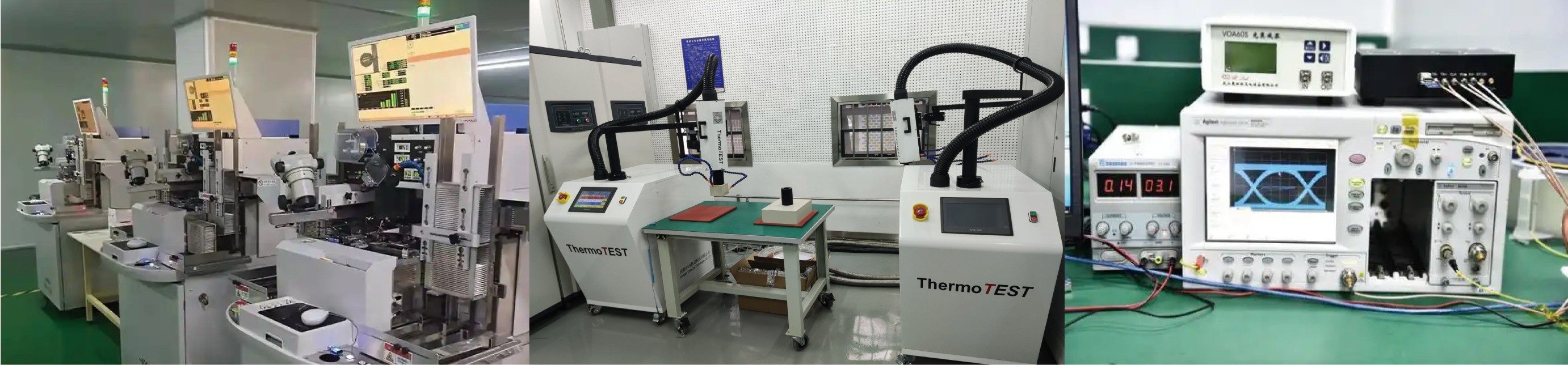
Professional Testing Environment for 800G OSFP Transceiver
Op2Link’s Testing Center has most of the mainstream brand switches and devices. Before shipment, we will test them on the corresponding switches to ensure the transceivers are 100% compatible with your system. And for the performance testing, we are stringently select a series of items in a professional testing environment to ensure the perfect blend of product performance and reliability.
When deploying 800G, the biggest challenge isn’t just the module—it’s the MPO-16 cabling infrastructure. A single speck of dust on a 16-fiber ferrule can drop multiple 100G lanes. At Op2Link, we don’t just provide the transceiver; we offer a validated 800G Ecosystem including MPO-16 jumpers and cleaning kits to ensure your 800G fabric stays up 24/7.
800G Optical Module Application & Solutions: Powering the Terabit Era
The 800G SR8 is the backbone for Generative AI (LLM) Training, High-Frequency Trading, and Terabit Ethernet Backbones. It enables the massive I/O throughput required by NVIDIA H100, AMD Instinct™, and Intel Gaudi® 3 clusters.
Designing Your 800G High-Speed Fabric?
Choosing between QSFP-DD800 and OSFP, or calculating the FEC (Forward Error Correction) impact on latency, can be complex.Op2Link’s engineering team provides detailed interoperability reports for Arista, Cisco, and NVIDIA-Mellanox environments. We help you solve the “thermal-to-density” puzzle to ensure your 800G migration is seamless and cost-effective.