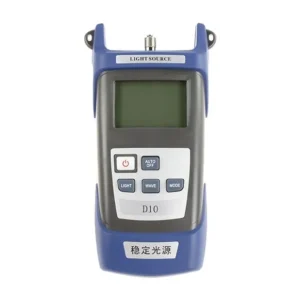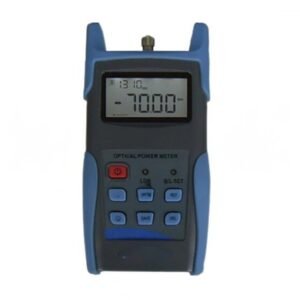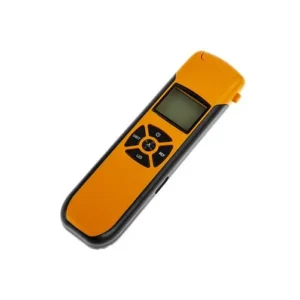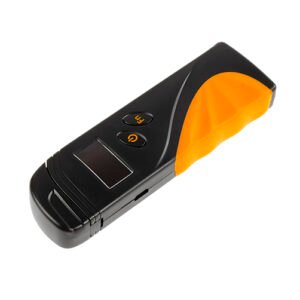
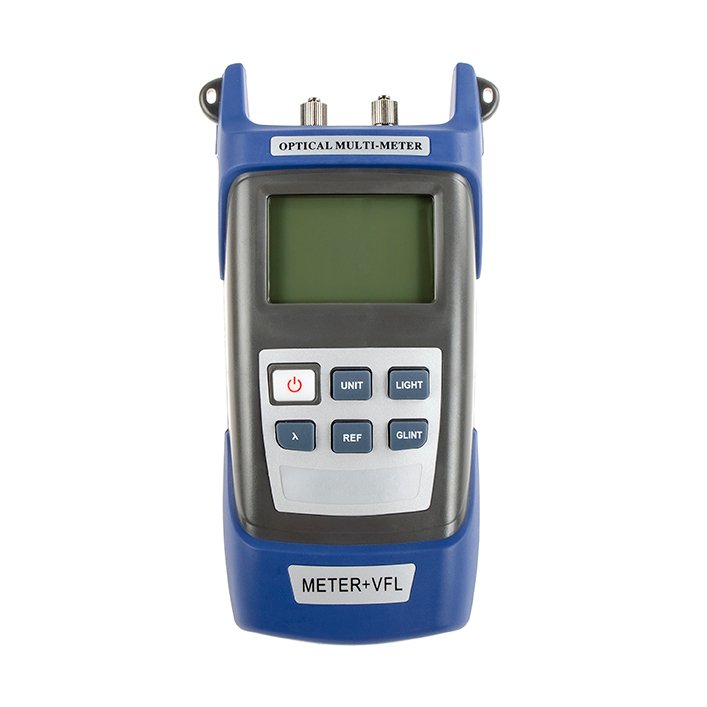
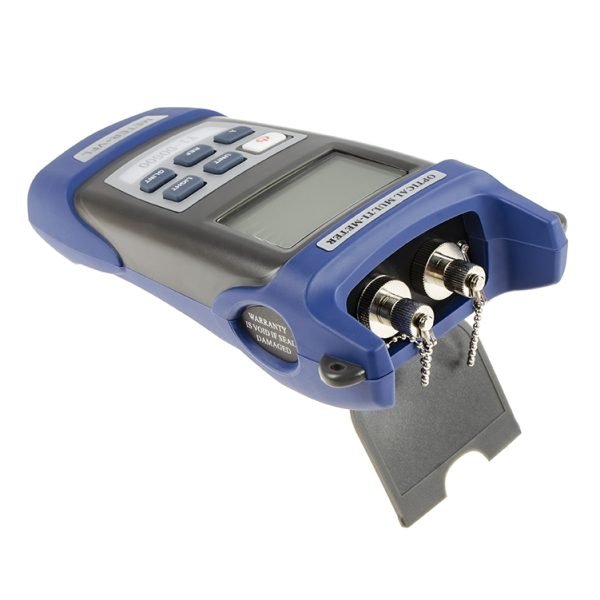
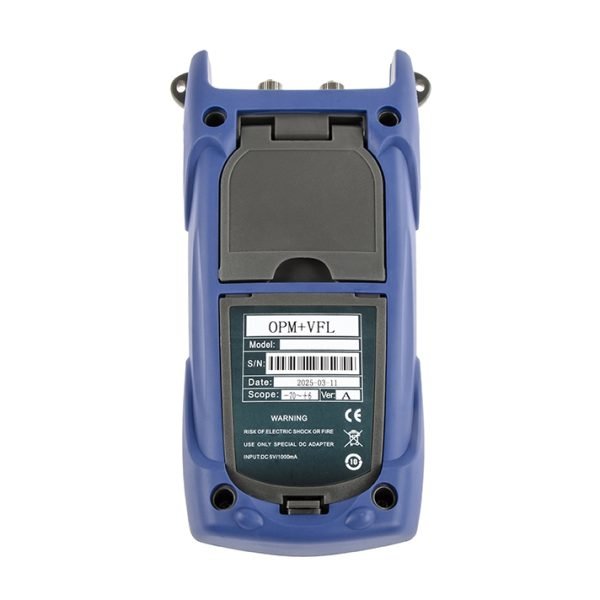
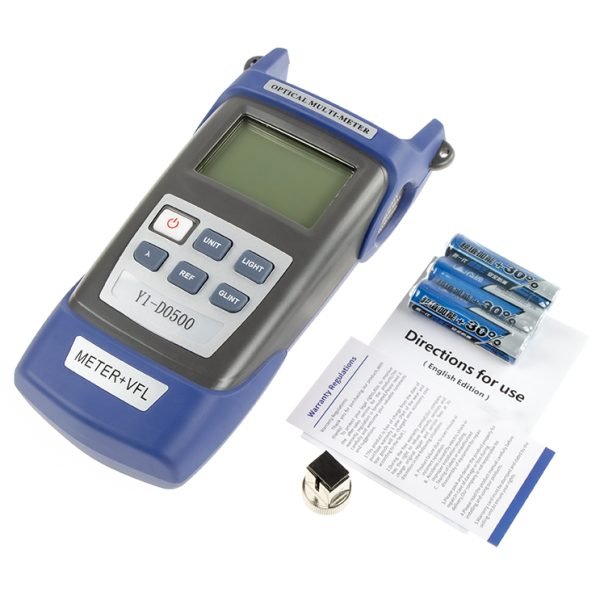
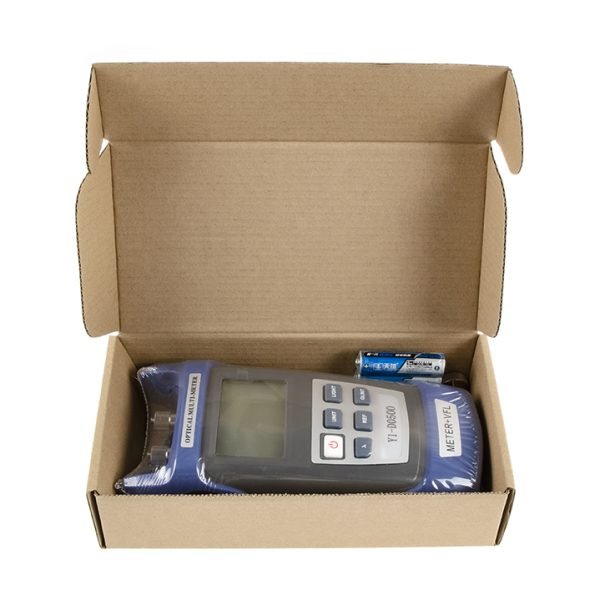
The Y1 Optical Power Meter + VFL All-in-One is a handheld fiber optic testing device, integrating optical power measurement and fiber line fault detection into one unit. Engineered with a single-chip microprocessor, this device ensures precise, reliable, and stable performance for fiber optic construction, maintenance, and testing.
Designed with an ergonomic and compact body, it features high-performance detectors and laser protection, ensuring accurate readings and safety during use. The built-in wavelength memory and user-friendly calibration options make it an essential tool for fiber optic engineers.
Product Specifications
| Parameter | Specification |
| Wavelength Range | 800~1700 nm |
| Connector Type | FC, SC (Standard), ST (Optional) |
| Detector Type | InGaAs |
| Power Measurement Range | -70~+6 dBm, -70~+10 dBm, -50~+26 dBm |
| Measurement Uncertainty | ±5% |
| Standard Wavelengths | 850/980/1270/1300/1310/1490/1550/1577/1625 nm |
| Display Resolution | Linear: 0.1%, Logarithmic: 0.01 dBm |
| VFL Wavelength | 650 nm (Integration Machine Series) |
| VFL Power Output | 1MW, 5MW, 10MW, 20MW, 30MW (Optional) |
| Operating Temperature | -10°C ~ +60°C |
| Storage Temperature | -25°C ~ +70°C |
| Auto Power-Off | 10 minutes |
| Battery Life | ≥48 hours |
| Dimensions | 190 × 100 × 49 mm |
| Power Supply | 3 × No.5 Batteries or Rechargeable Li Battery |
| Weight | 254~282 g |
Selection Notes
- Typically selected when technicians want to carry one handheld unit for both power/loss checks (OPM) and quick visual fault tracing (VFL), and the team can keep a consistent routine for wavelength selection, reference setting, and mode switching.
- May not be appropriate for organizations that cannot standardize the OPM measurement-range variant and the VFL output-power option, or where crews frequently share devices without a consistent reset/cleaning habit, since mixed configurations and leftover settings commonly reduce measurement comparability and slow troubleshooting.
Feature Details
- Absolute and Relative Power Measurement: Displays both linear (mW) and non-linear (dB) values for precise readings.
- Self-Calibration Function: Users can manually calibrate the device for better accuracy.
- Red Light Fault Detection: Supports constant and flashing modes to help locate fiber breaks and faults.
- Wavelength Memory Function: Automatically recalls the last used wavelength.
- Multiple Power Supply Options: Supports both battery and external power for flexible operation.

Application Details
- Absolute Power Measurement:When a fiber with a known 1310 nm wavelength is connected, the device displays both linear and logarithmic power values.
- Relative Power Measurement:Allows setting a reference power level for measuring signal loss in fiber optic networks.
Other Extended Information
Standard Configuration
✔ Main Unit
✔ 3 × No.5 Batteries (Optional)
✔ SC & FC Adapter (ST Optional)
✔ Warranty Card & Certification
✔ Oxford Soft Bag (Optional)
✔ Data Cable (Optional)
✔ Built-in Li Battery & Charger (Optional)
Charging Function (Optional)
- If the battery power is insufficient, the power index will flashevery second for 10 seconds before the device shuts down.
- Use the designated chargerto avoid damage.
Daily Maintenance & Repair
- Keep the sensor clean and free from dust and grease.
- Use one standard adapter consistentlyto avoid scratches.
- Cover the dust cap when the device is not in use.
- Clean the sensor surface with a professional cleaning swabfor accurate readings.
Quality Guarantee
- 12-month warrantyfor material and manufacturing defects.
- The warranty excludesdamages due to accidents, improper use, or unauthorized repairs.
FAQ
Q1: What functions does the Y1 combine?
Optical power measurement (OPM) + Visual Fault Locator (VFL).
Q2: What VFL power range is available?
VFL output power may include 1 mW, 5 mW, 10 mW, 20 mW, or 30 mW, depending on the configuration.
Q3: How many wavelengths does the OPM support?
Typically 850/1300/1310/1490/1550/1625nm.
Q4: Does it replace separate tools?
Yes, combining two essential functions saves time and equipment load.
Q5: What networks is it designed for?
FTTH/PON, enterprise networks, telecom maintenance, and lab setups.
Q6: Is it rechargeable?
Power supply options include AA batteries or a built-in rechargeable lithium battery, depending on the model.
Q7: Will it work with LC connectors?
Yes, with an LC adapter.