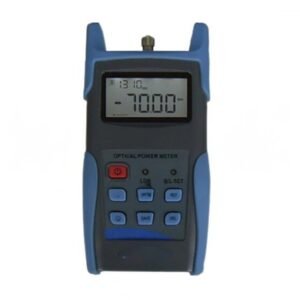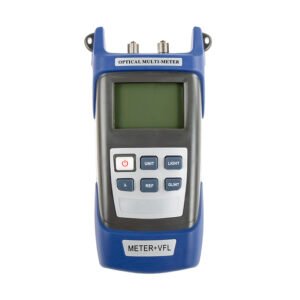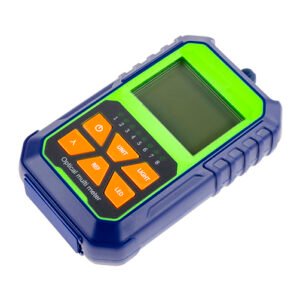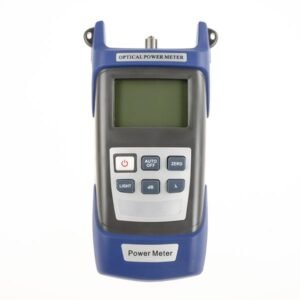
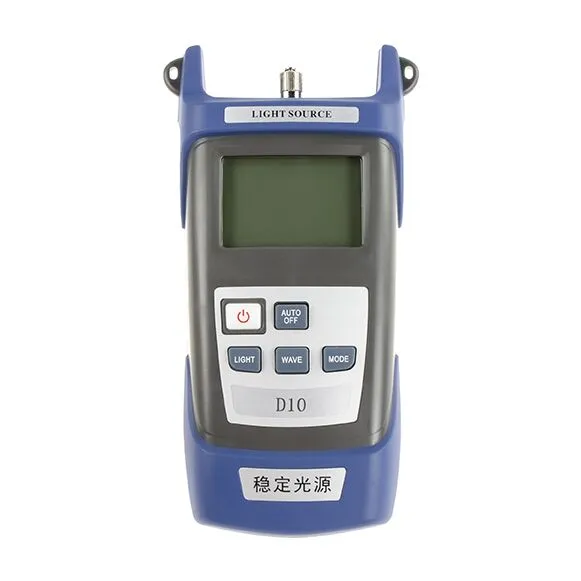
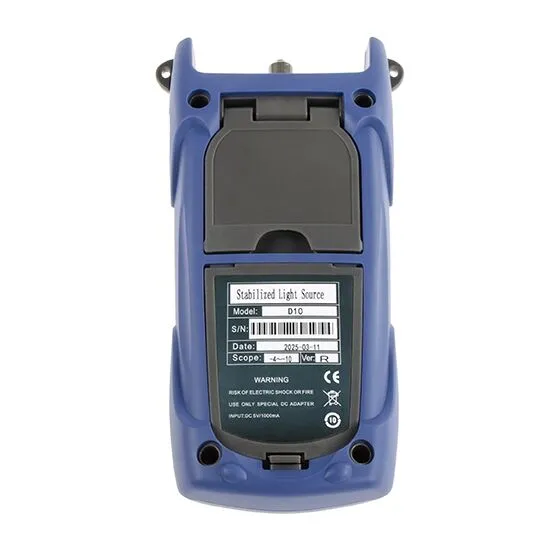
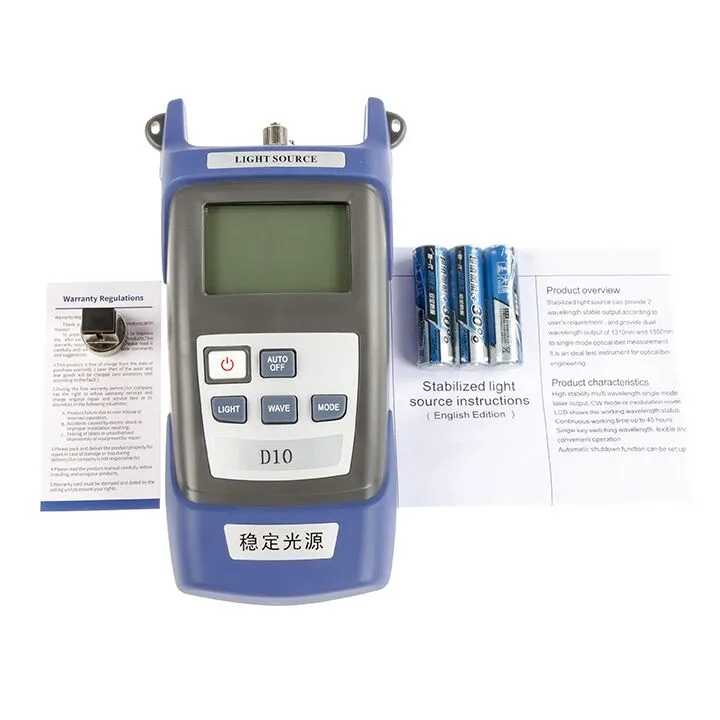
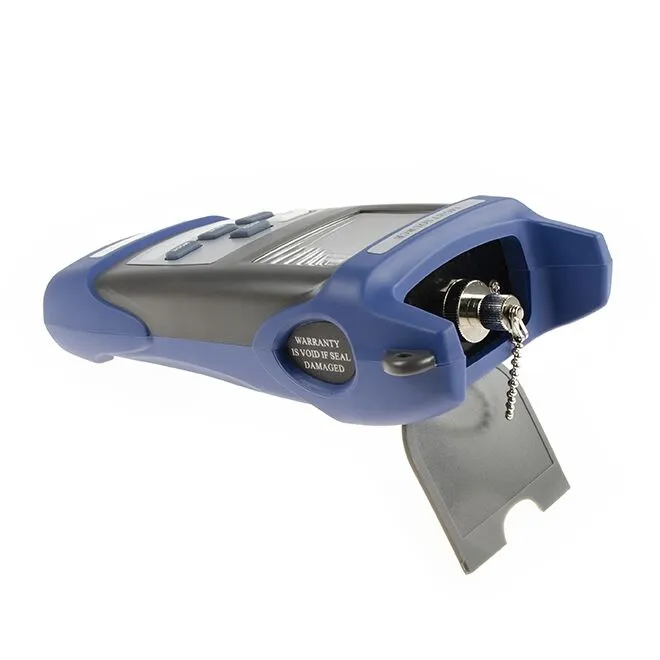
The W1S Handheld Stabilized Light Source is a high-stability, multi-wavelength optical tester, offering laser emission at 1310nm, 1550nm, and 650nm for comprehensive fiber optic testing. Designed for fiber network engineers and technicians, this device provides a consistent and precise laser output, enabling accurate fiber fault detection and link verification.
With an ergonomic design, LCD display, and universal fiber connectors, the W1S light source ensures efficient field testing and maintenance. It offers long-lasting battery life, multiple power supply options, and auto shutdown for extended usage. Whether for FTTH deployment, fiber link troubleshooting, or lab applications, the W1S is an essential tool for fiber optic professionals.
Product Specifications
| Parameter | Specification |
| Adjustable Power Range | -4 ~ 10 dBm |
| Working Wavelength (nm) | 1310 / 1550 (Regular Configuration) |
| Static Current | ≤18 μA |
| Operating Current | ≤60 mA |
| Continuous Operation | ≥45 hours |
| Charging Voltage | 5V |
| Charging Current | ≤500 mA |
| Charging Time | ≤3 hours |
| Auto Shutdown | 10 minutes |
| Power Source (Optional) | Rechargeable Lithium Battery, External DC Input |
| Battery Capacity | 1500 mAh |
| Dimensions (mm) | 192 × 72 × 42 |
| Weight (g) | 400 |
Feature Details
- High-Precision Optical Output– Stable laser emission for accurate fiber signal testing.
- Multi-Wavelength Operation– Provides 650nm visible light for fault detection and 1310/1550nm for telecom fiber verification.
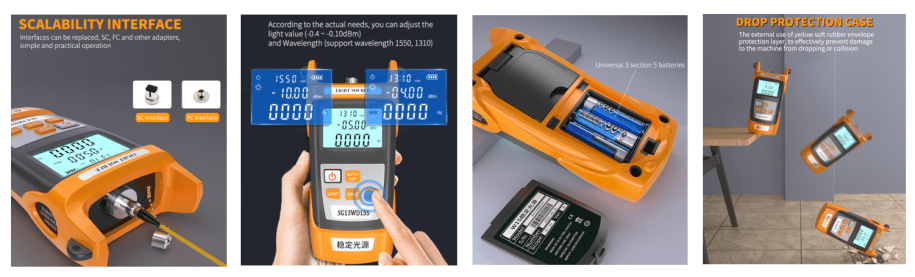
- LCD Display– Displays real-time wavelength, power status, and operation mode.
- One-Touch Wavelength Switching– Simplifies fiber testing by toggling wavelengths with a single button.
- Smart Power Management– Auto shutdown extends battery life during inactive periods.
- Multiple Power Supply Options– Supports USB 5V charging, lithium battery, and AA batteries.
- Adjustable Optical Path– Ensures precise signal output for different fiber testing applications.
Application Details
- Fiber Network Deployment & Testing– Ensures precise fiber optic transmission during FTTH and telecom network installations.
- Troubleshooting & Maintenance– Quickly identifies fiber signal loss, attenuation, and link issues.
- Laboratory Research & Optical Component Testing– Provides a stable and adjustable light source for lab analysis.
- Telecom & Data Center Fiber Verification– Essential for network integrity checks in high-speed fiber environments.
Charging Function
- Standard DC +5V Charging Interface– Compatible with USB power sources.
- Smart Charging Indicator– LED flashes during charging and stops when fully charged (optional feature).
Standard Configuration
- Main Device
- User Manual
- Product Warranty Card
- Certificate of Conformity
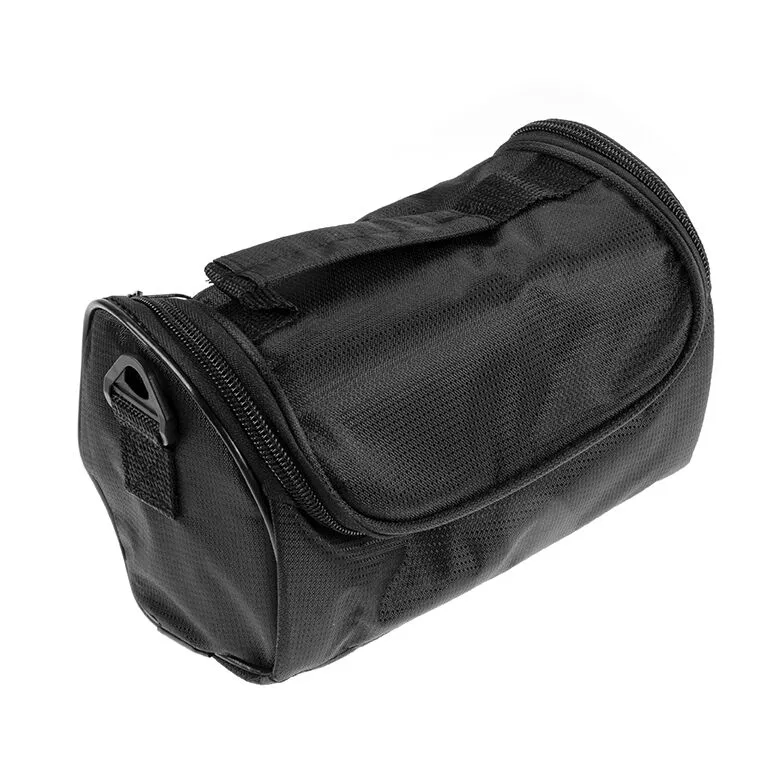
- Cowhide Soft Carrying Bag
- Rechargeable Lithium Battery (Optional)
- 3 × AA Batteries (Optional)
- Charger (Optional)
Maintenance & Precautions
- Keep Sensor Clean– Regularly clean the sensor end to avoid grease and contamination.
- Avoid Non-Standard Adapters– Using improper connectors may damage the sensor end face.
- Dust Protection– Always close the dust cap when not in use.
- Careful Handling– Avoid scratching or excessive force when plugging/unplugging connectors.
- Periodic Cleaning– Use specialized fiber cleaning swabs to maintain sensor accuracy.
Common Issues & Troubleshooting
| Issue | Possible Cause | Solution |
| LCD Display is Dim | Low battery | Charge the device |
| No Display on Startup | Low battery or system error | Restart or charge |
| Abnormal Display Data | Dirty or faulty connector | Clean and reconnect |
Selection Notes
- Typically selected when teams need a portable stabilized source for 1310/1550 link verification (with a compatible power meter) while also wanting a 650nm visible aid for continuity/fault visibility, and they can standardize output-power settings and modulation usage.
- May not be appropriate for organizations that cannot control a consistent routine for output-power level, wavelength selection, and modulation mode, since mixed settings commonly reduce comparability in loss measurements and make field records harder to reproduce across crews/sites.
FAQ
Q1: What wavelengths are available for W1S?
Common options include 1310/1490/1550 nm or customized wavelengths.
Q2: How stable is the output?
Laser output drift is minimized, ensuring accurate long-term measurement.
Q3: Does it support modulation?
Yes—CW, 270Hz, 1kHz, and 2kHz.
Q4: Is it compatible with all standard OPMs?
Yes, works with most optical power meters on the market.
Q5: What type of connectors does it use?
SC/FC/ST interchangeable interfaces.
Q6: Is the device suitable for field operations?
Yes, rugged design and long battery life support outdoor work.
Q7: What industries commonly use it?
FTTH deployment, telecom network maintenance, and fiber equipment calibration.