

Tight Buffer vs Loose Tube Fiber Introduction
When planning a fiber optic network, one of the first decisions you face is choosing tight buffer vs loose tube fiber optic cables. These two designs may sound similar, but they are built for entirely different environments and installation methods. Selecting the wrong type can raise costs, complicate installation, or even put your network at long-term risk.
The core distinction lies in the relationship between the fiber and its protective layer: loose tube fiber optic cables allow fibers to move freely inside protective tubes, making them the standard choice for harsh outdoor and long-distance environments, while tight buffer fiber optic cables encapsulate each fiber with an additional buffer coating, making them the ideal choice for indoor and short-distance applications. This article explains the principles, technical details, and application scenarios to help you make the best decision.
What is Loose Tube Fiber? Structure and Advantages
Loose Tube Fiber Structure and Design
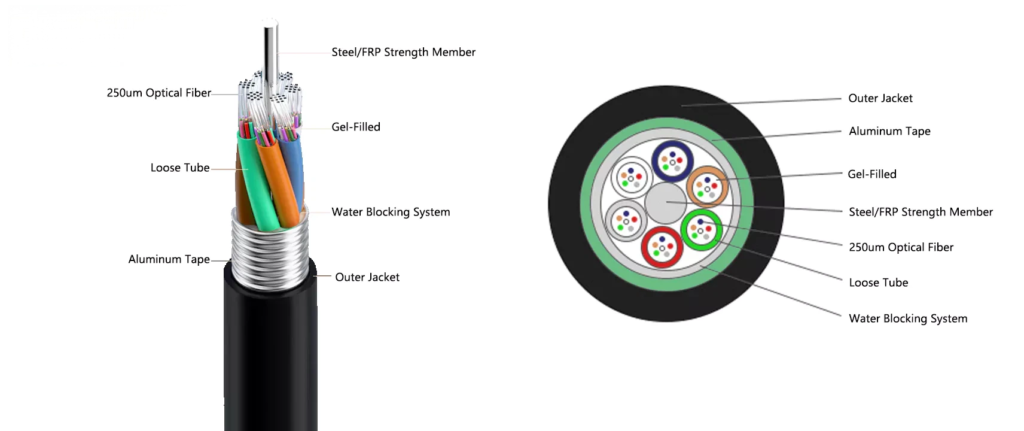
Loose tube fiber cable is engineered for durability outdoors. The optical fibers are loosely housed within water-blocked gel-filled tubes made of high-modulus PBT (Polybutylene Terephthalate), which are stranded around a central strength member, typically steel or fiberglass (FRP). This core is often protected by an armored jacket like corrugated steel or an aluminum polyethylene laminate (APL) moisture barrier. The design includes excess fiber length (0.1%-0.3%) to ensure fibers remain stress-free under temperature swings (−40°C to +70°C).
Key Advantages of Loose Tube Fiber
Durable outdoors: Performs across extreme temperatures, UV exposure, and high humidity. The “loose” design allows the fibers to move slightly, protecting them from mechanical stress and temperature-induced expansion/contraction. The gel prevents water penetration.
High tensile strength: 600–1000N (long-term), 1500–3000N (short-term).
High fiber density: Efficient for large-capacity backbones, making these cables perfect for OSP (Outside Plant) applications like direct burial, aerial installation, and duct conduit. They are the backbone for long-haul telecommunications, FTTx (Fiber to the x) networks, and campus links.
What is Tight Buffer Fiber? Structure and Advantages
Tight Buffer Fiber Structure and Design
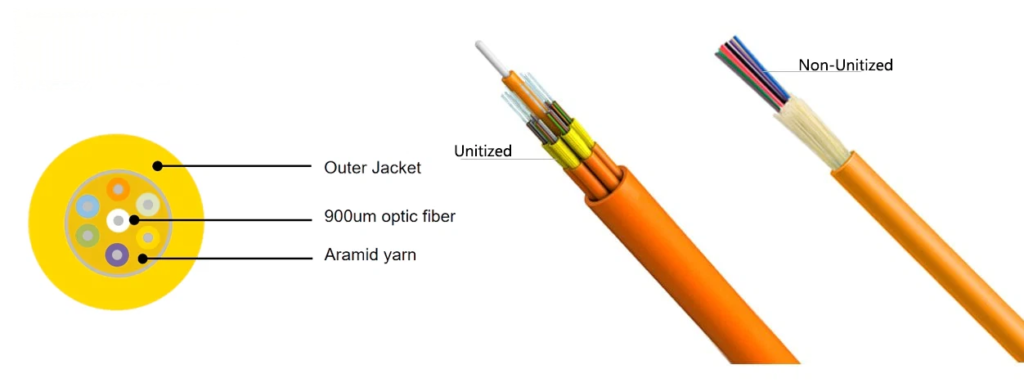
A tight-buffered fiber cable is the standard choice for indoor and short-distance applications. In this design, each individual optical fiber is coated with a thick, durable plastic layer (the 900µm “tight buffer”) that fits snugly around the primary coating, providing dual-layer protection. These ruggedized fibers are then bundled together with strength members, typically aramid yarn (like Kevlar®), and an outer jacket, which is often a flame-retardant LSZH jacket compliant with indoor fire codes.
Key Advantages of Tight Buffer Fiber
Easy termination: The key advantage is ease of termination; the robust design allows fibers to be directly connectorized without needing a splice tray, fan-out kit, or cleaning gel. This makes tight-buffered cables ideal for pre-terminated trunk cables, patch cords, riser (OFNR), and plenum (OFNP) rated installations.
Flexible installation: Small bend radius (5–8 × cable diameter), perfect for tight spaces within buildings, data centers, and for horizontal cabling.
Fire safety: Plenum-rated and riser-rated LSZH options meet NFPA 262 standards, ensuring indoor reliability for LANs, SANs, and equipment patching.
Tight Buffer vs Loose Tube Fiber: Technical Comparison
| Performance Indicator | Loose Tube Fiber Cable | Tight Buffer Fiber Cable | Standard |
| Long-Term Tensile Strength | 600–1000N | 200–400N | IEC 60794-1-2-E1 |
| Crush Resistance | ≥3000N/10cm | ≥1000N/10cm | IEC 60794-1-2-E3 |
| Minimum Bend Radius | 10–15 × D | 5–8 × D | IEC 60794-1-2-G1 |
| Operating Temp. | −40°C to +70°C | −20°C to +60°C | IEC 60794-1-2-F1 |
| Water Resistance | 3m, 24h, no seepage | 1m, 1h, no seepage | IEC 60794-1-2-F9B |
| Fire Rating | Standard PE jacket | LSZH plenum/riser rated | IEC 60332-3-22 |
| D = Cable Outer Diameter |
This table highlights the tight buffer vs loose tube fiber performance differences for quick selection.
Tight Buffer & Loose Tube Fiber Application Case Studies
Case Study 1: Loose Tube Fiber for Outdoor Project
Scenario: Yangtze River crossing, 3.2 km span, 45 m water depth, 95% humidity
Solution: Steel-armored loose tube (GYTA53) with tensile strength ≥60kN
Results: Stable operation, attenuation variation ≤0.02 dB/km over 3 years
Case Study 2: Tight Buffer Fiber in a Data Center
Scenario: Financial data center, 10,000 fibers, 288 patching zones
Solution: Tight buffer pre-terminated cables with plenum rating
Results: 800 terminations/day, 45% faster installation, 35% labor savings
Tight Buffer & Loose Tube Fiber Selection Guide
Step-by-Step Process
Environment: Outdoor/harsh → Loose Tube Fiber Cable / Indoor/data center → Tight Buffer Fiber Cable
Fire Safety: Plenum/air handling spaces → Tight Buffer LSZH cable
Installation Speed: Fast deployment → Tight Buffer Fiber
Fiber Density: High fiber count → Loose Tube Fiber
Certification: Verify UL/ETL listings for compliance
Quick Checklist
Define operating environment
Confirm flame rating requirements
Assess installation timeline and manpower
Calculate fiber density and expansion needs
Check supplier qualifications
Tight Buffer & Loose Tube Fiber Technology Trends
Gel-Free Loose Tube Fiber: Uses SAP powders or tapes instead of gel, cutting installation time by 50%.
Micro Loose Tube Design: Loose tubes ≤1.0mm diameter, increasing fiber density by ~30%, popular for 5G and hyperscale data centers.
FAQ of Tight Buffer & Loose Tube Fiber
Q1: What is loose tube fiber and where is it used?
Loose tube fiber optic cable is designed for outdoor networks (OSP), offering strong mechanical protection, water resistance, and high fiber density. It’s perfect for direct burial, aerial installation, and duct conduit.
Q2: What are the advantages of loose tube fiber over tight buffer fiber?
Loose tube offers better tensile strength, wider operating temperature range, superior water resistance, and higher fiber density, making it ideal for OSP backbones and harsh environments.
Q3: What is tight buffer fiber, and why is it used indoors?
Tight buffer fiber features easy termination (no gel cleanup, direct connectorization), small bend radius, and flame-safe LSZH jackets, making it perfect for indoor installations like LANs, data centers, and horizontal cabling.
Q4: Can outdoor loose tube fiber be run indoors?
Not directly. Standard PE jackets fail fire codes. Use indoor-outdoor rated loose tube cable with an LSZH jacket for transitions.
Q5: Is tight buffer fiber more expensive?
Generally yes due to more material used, but savings on installation time and termination costs often outweigh the higher material costs in indoor applications like data centers.
Tight Buffer vs. Loose Tube Fiber Conclusion
The choice between tight buffer vs loose tube fiber optic cables is not about which is better overall-it’s about which is better for your specific application:
Loose Tube Fiber → Best for outdoor, high fiber count, harsh conditions, and long-distance OSP projects.
Tight Buffer Fiber → Best for indoor, fast installation, fire-safe cabling, and data center environments.
With this guide covering principles, engineering practice, and selection criteria, you can now confidently choose the right fiber optic cable for your project-balancing cost, safety, and long-term network reliability.
Information based on IEC and Telcordia standards.