
The “last mile” in fiber optic networks brings high-speed internet directly to your doorstep. This critical connection is made possible by fiber drop cable. With over a decade of experience in fiber optic manufacturing, Op2Link helps customers choose the right drop cables and provides expert support along the way. This guide will explain what fiber drop cables are, why they matter, and how to select the most suitable one for your network.
What is a Fiber Drop Cable?

A fiber drop cable is a lightweight, flexible, and durable fiber optic cable specifically designed for the “last 100 meters” or “last mile” of FTTH (Fiber-to-the-Home) networks. It typically extends from a utility pole or building entry point-usually a terminal or splitter-directly to the customer’s home, ultimately connecting to the Optical Network Terminal (ONT).
Think of the internet as a vast highway system. The backbone fiber acts as a high-capacity expressway, delivering network connectivity to communities. Distribution cables branching into neighborhoods serve as exit ramps, while fiber drop cables function as private driveways, delivering high-speed internet, TV, and phone services directly to your home.
Key Features of Fiber Drop Cable
·Safety and Environmental Compliance
LSZH (Low Smoke Zero Halogen) jackets meet fire-retardant and environmental standards, making them safe for indoor installation.
·Lightweight and Flexible
Simple structure, low weight, and high flexibility make installation easy in buildings, conduits, or tight spaces.
·Enhanced Mechanical Performance
Optional FRP, steel, or armored layers improve tensile strength, crush resistance, and overall durability.
·Excellent Bend Performance
Uses bend-insensitive fiber (G.657A1/A2) to maintain low loss even at small bending radii, ideal for complex indoor layouts.
·Easy Installation and Maintenance
Cable design allows for simple stripping and splicing, improving installation efficiency.
Factory pre-terminated options support plug-and-play deployment, reducing field splicing and installation time.
·Strong Environmental Adaptability
Outdoor versions include waterproof layers, UV-resistant jackets, and temperature-tolerant designs for long-term reliability.
Suitable for aerial, direct-burial, wall-mounted, and indoor/outdoor transition applications.
Common Types of Fiber Drop Cable
Not all fiber drop cables are the same. Each type is designed for specific environments and installation challenges. Below is an overview of the most commonly used drop cable types in FTTH and FTTR networks. These cables can vary by environment (indoor/outdoor), structure (round/flat/figure-8), reinforcement (FRP/steel/all-dielectric/armored), and functionality (hybrid fiber-power/pre-terminated).
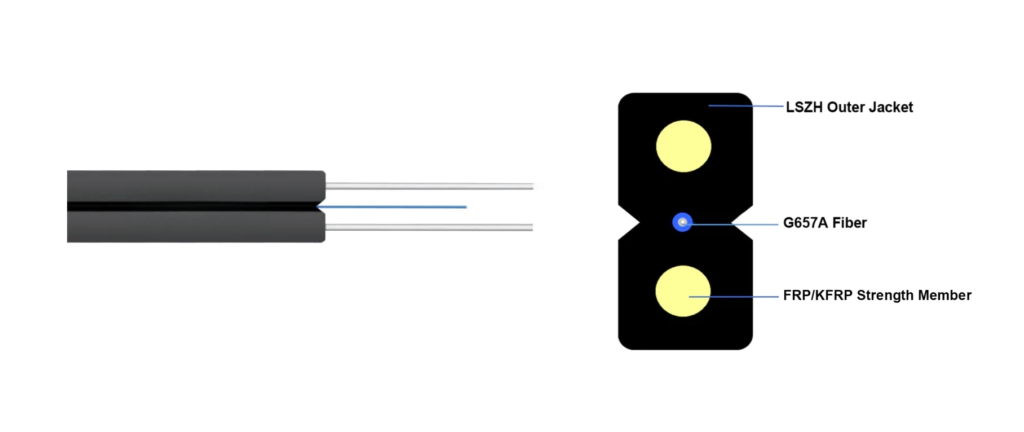
Indoor Fiber Drop Cable with FRP Reinforcement
Applications: Indoor installations along baseboards, under carpets, or in conduits.
Features: Lightweight, extremely flexible, reinforced with non-metallic FRP rods for bend resistance, LSZH jacket for fire safety, and streamlined design for concealed installation.
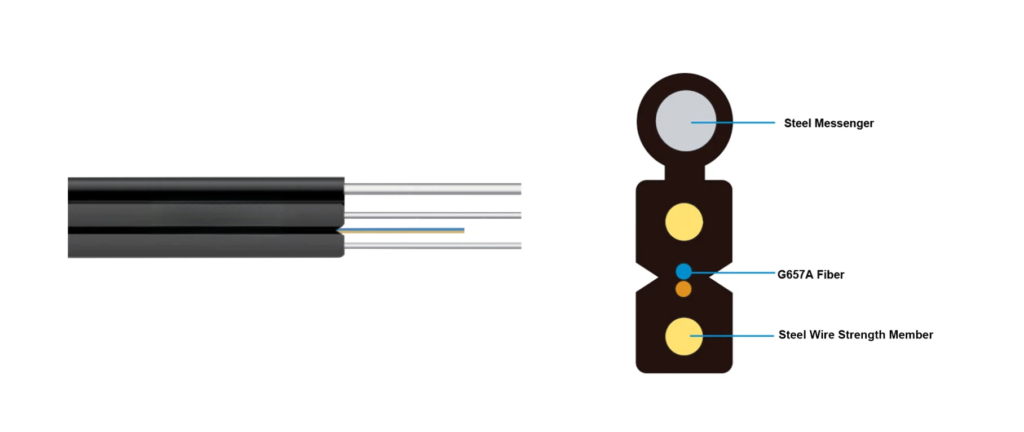
Outdoor Self-Supporting Figure-8 Fiber Cable
Applications: Aerial installations between poles or connecting building exteriors.
Features: Figure-8 design with an integrated support messenger (steel or dielectric), allowing long aerial spans without additional support, ensuring safe and economical installation.
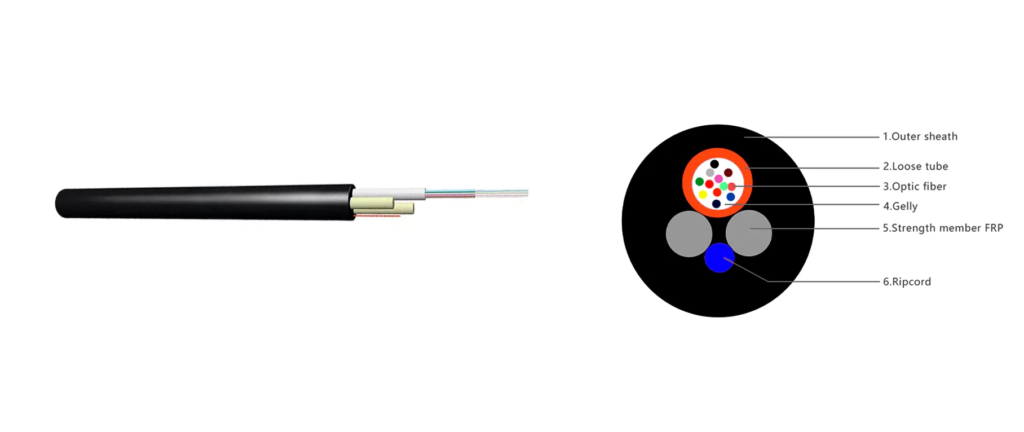
All-Dielectric Self-Supporting (ADSS) Cable
Applications: Aerial deployment in areas prone to lightning or high electromagnetic interference (EMI), such as near high-voltage power lines.
Features: Fully dielectric, naturally resistant to lightning and EMI, ensuring reliable and safe connections in challenging environments.
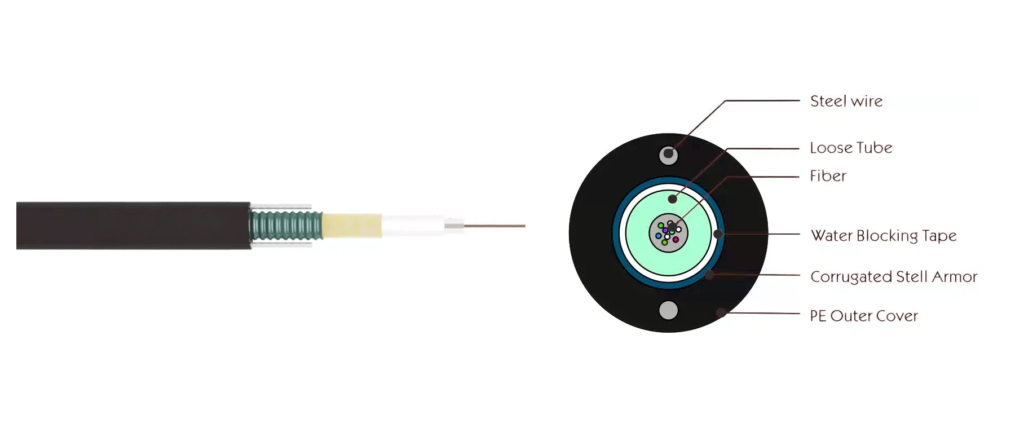
Armored Fiber Drop Cable
Applications: Direct burial, conduit installations, or areas with rodent activity.
Features: Robust steel or aluminum armor under the jacket protects the fiber from compression, rodents, and mechanical damage, ideal for harsh conditions.

Flat Fiber Drop Cable
Applications: Indoor or outdoor installations requiring aesthetic, low-profile routing along walls, window frames, or door frames.
Features: Flat design adheres to surfaces; dual FRP reinforcement rods enhance durability. Can be mounted using clips for neat, professional installations.
Options: All-dielectric or toneable for underground fault detection
1–24 fibers for varying network needs
Gel-filled (moisture-resistant) or dry core (lighter and easier to install)
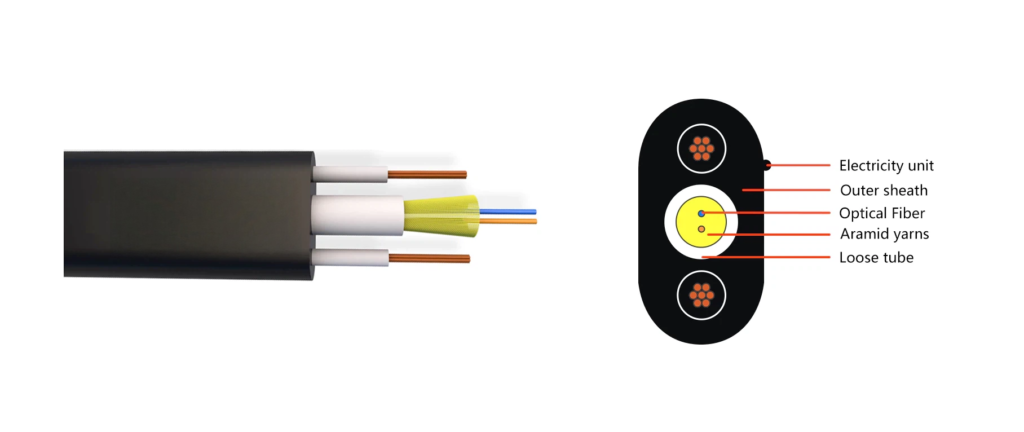
Hybrid Fiber and Power Drop Cable
Applications: Powering remote devices like WiFi access points, 5G small cells, or surveillance cameras.
Features: Combines optical fibers and copper conductors in a single jacket, transmitting both data and power in one run, simplifying installation and reducing costs.
Advantages of Fiber Drop Cable
·Fast Deployment & Easy Maintenance
Designed for efficient installation, cables can be pulled through conduits or mounted along walls. Pre-terminated or hybrid designs reduce field splicing, saving time and labor.
·High Reliability & Signal Stability
Quality reinforcement and jacket design minimize bend loss and microbends, ensuring consistent optical performance and reducing long-term maintenance costs.
·Wide Environmental Compatibility
Temperature-resistant, UV-resistant, and EMI-resistant designs. Armored options protect against rodents, compression, and mechanical damage for direct-burial or conduit installations.
·Scalability & Network Flexibility
Available in multiple fiber counts (1–24) and various structures (flat, round, figure-8). Hybrid fiber-power cables deliver both electricity and data, supporting diverse applications.
·Cost-Effectiveness & ROI
Lightweight and easy-to-install cables reduce labor costs. Durable construction decreases replacement frequency, maximizing network investment return.
·Safety & Standards Compliance
LSZH jackets and high fire-resistance levels improve building safety. Compliant with international standards (ISO, IEC), ensuring interoperability and reliability.
Installation Guidelines of Fiber Drop Cable
| Bend Radius | Avoid excessive bending to prevent microbends or fiber breakage.Maintain ≥10× cable diameter (for flat cables, follow manufacturer recommendations). |
| Tensile Limits | Pull force should not exceed the cable’s rated maximum (usually ≤100 N).Use rollers or conduit pulls to prevent concentrated stress at cable ends.Follow tension specifications for self-supporting or aerial cables. |
| Connection Methods | Fusion Splicing: Low loss (≤0.05 dB), suitable for long-term stability.Mechanical / Pre-Terminated: Quick deployment, slightly higher loss (≤0.2 dB), requires periodic inspection. |
| Labeling & Management | Number and label each cable and fiber core for easy maintenance, expansion, and fault detection. |
| Environmental Protection | Avoid prolonged exposure to high temperature, humidity, chemicals, or strong UV.Outdoor cables should use appropriate jackets (LSZH, PE, or armored) and comply with the manufacturer’s environmental specifications. |
| Additional Tips | Reserve Slack for future maintenance and upgrades.Avoid sharp bends at termination points (adapter, splitter), typically ≥20 mm radius.Test with OTDR or optical power meter to confirm loss and performance. |
FAQ of Fiber Drop Cable
1. What is the difference between pre-terminated and field-spliced fiber drop cables?
Pre-terminated: Connectors are installed at the factory, offering plug-and-play convenience, reducing installation time and labor costs.
Field-spliced: Fiber ends are spliced on-site, providing flexibility but requiring more time and technical skill.
2 . Can fiber drop cables be used both indoors and outdoors?
Yes. Some drop cables are rated for both indoor and outdoor use. Indoor cables typically feature LSZH (Low Smoke Zero Halogen) jackets, while outdoor cables offer UV resistance, waterproofing, and temperature tolerance. For indoor-outdoor transitions, use dual-rated cables or protective conduits.
3. What fiber types are used in drop cables?
Single-mode fiber (G.657A1/A2): Bend-insensitive, low-loss, ideal for FTTH/FTTR networks.
Multimode fiber: Rarely used in access networks, mainly for short-distance indoor connections.
4 . How many fibers can a drop cable contain?
Fiber count typically ranges from 1 to 24:
1–4 fibers: Suitable for single-family homes.
12–24 fibers: Suitable for multi-dwelling units (MDU) or commercial buildings.
5. How long do fiber drop cables last?
With proper installation and environmental protection, fiber drop cables can last 20–30 years, maintaining stable performance and low failure rates. Armored or UV-resistant cables provide even greater durability for outdoor applications.