
- What is SFP (Small Form-factor Pluggable): A Flexible Basic Choice
- What is SFP+ (Enhanced Small Form-factor Pluggable): The Benchmark for 10G Networks
- What is QSFP+ (Quad Small Form-factor Pluggable Plus): The 40G High-Speed Transmission Solution
- What is QSFP28: The Core Component of the 100G Era
- What is QSFP-DD (Double Density QSFP): The High-Speed Interface for the Future
- Comparison of SFP, SFP+, SFP28, QSFP+, QSFP28, QSFP-DD Fiber Transceiver
- Key Differences and Compatibility of SFP, SFP+, SFP28, QSFP+ and QSFP28
- Applications and Selection Guide
- Fibermart Fiber Transceiver Product Selection Guide
- Frequently Asked Questions FAQs
- Are SFP and SFP+ the same?
- Can I use an SFP transceiver in an SFP28 port?
- Is multimode fiber no longer usable for 400G networks?
- What are typical applications for QSFP28?
- Does QSFP28 support 10G?
- Is QSFP-DD the preferred form factor for 400G deployment?
In data center server rooms, rows of switches blink with various indicator lights. Among them, the inconspicuous small Fiber Transceivers are silently transmitting massive amounts of data at speeds of hundreds of gigabits per second, forming the neural network of the digital age. Fiber Transceivers are the core components that enable photoelectric signal conversion. Despite their small size, they determine the upper limits of network performance. Different form factor Fiber Transceivers cater to various needs, from traditional enterprise networks to hyperscale data centers. This article will provide a detailed analysis of the technical characteristics, differences, and application scenarios of these five mainstream Fiber Transceiver types: SFP, SFP+, QSFP+, QSFP28, and QSFP-DD.
Understanding Fiber Transceiver Types. Before clarifying the differences between these transceivers, it’s important to understand what SFP, SFP+, SFP28, QSFP, and QSFP28 transceivers are. The following sections will introduce each.
What is SFP (Small Form-factor Pluggable): A Flexible Basic Choice
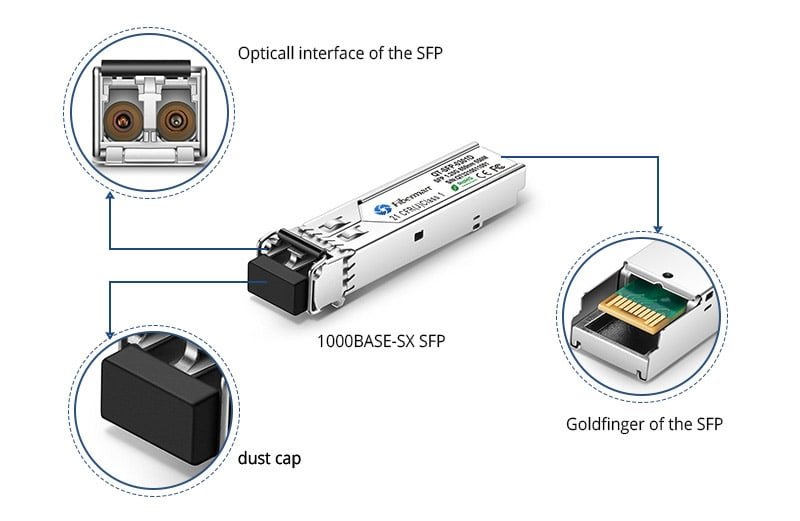
SFP transceivers are one of the most common types in network deployments, supporting transmission rates up to 4.25 Gbps. These hot-swappable transceivers are compact, offer strong compatibility, and are widely used in various environments such as Gigabit Ethernet and Fibre Channel.
Key Features:
● Speed: 155 Mbps to 4.25 Gbps
● Transmission Distance: Short Reach (SR) and Long Reach (LR) options
● Interface: Primarily LC duplex connectors
● Power Consumption: Typically less than 1W
Typical Applications: Enterprise-grade switches, routers, 1G/2G Fibre Channel storage networks.
What is SFP+ (Enhanced Small Form-factor Pluggable): The Benchmark for 10G Networks
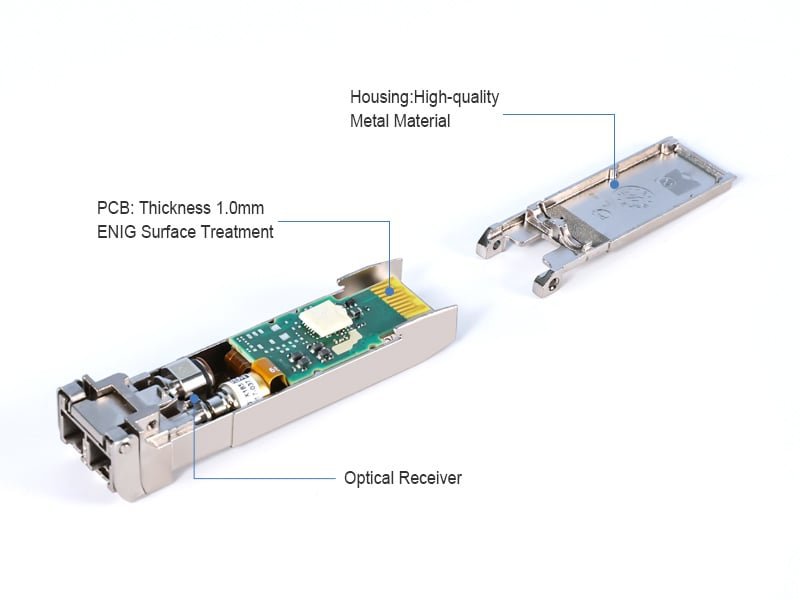
SFP+ is an upgraded version of SFP, sharing the same form factor but supporting higher data rates, up to 16 Gbps, with 10G being the most common application. Its backward compatibility allows many devices to support both SFP and SFP+ transceivers.
Key Upgrades:
● Speed: Up to 16 Gbps (most commonly 10G)
● Lower power consumption and latency
● Support for Direct Attach Copper (DAC) and Active Optical Cables (AOC)
● Widely used for 10GbE, 8G/16G Fibre Channel
If you are building a 10G network environment,Op2Link offers various high-quality SFP+ Fiber Transceiver, covering different transmission distances and wavelength options to meet the diverse needs of data centers and enterprise networks.
What is QSFP+ (Quad Small Form-factor Pluggable Plus): The 40G High-Speed Transmission Solution
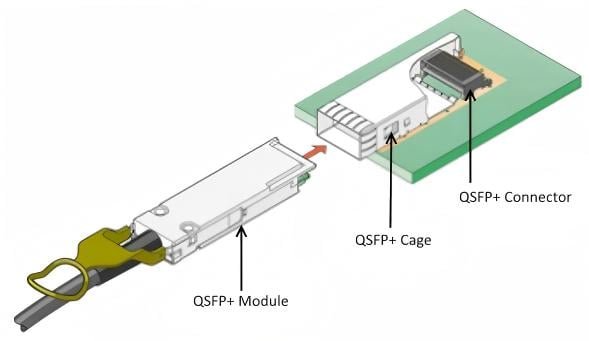
As data centers evolved, 40G networks became mainstream, leading to the development of QSFP+ transceivers. This module integrates four transmission channels in a single interface, each supporting 10Gbps, achieving a total bandwidth of 40G.
Notable Features:
● Quad-channel design for high-density deployment
● Speed: 40G (4×10G)
● Supports Breakout configuration (can be split into 4 independent 10G connections)
● Transmission distances from a few meters to tens of kilometers
For enterprises needing to upgrade to 40G networks, Op2Link’s QSFP+ transceiver provide a reliable and cost-effective solution, supporting various fiber types and transmission distances.
What is QSFP28: The Core Component of the 100G Era
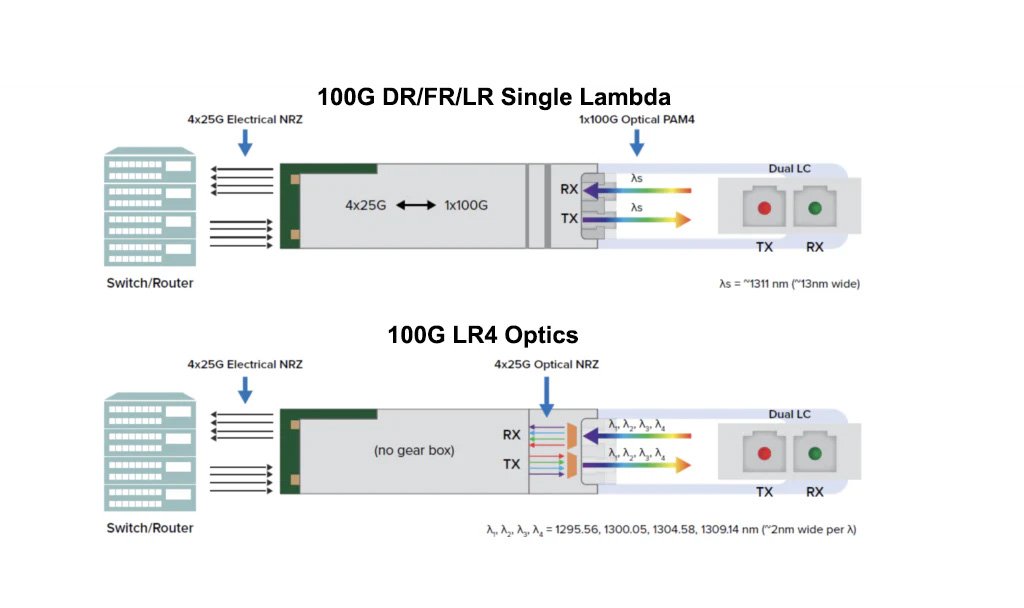
As the natural evolution of QSFP+, QSFP28 supports 25Gbps per channel, with four channels delivering a total bandwidth of 100G. It is currently the most common Fiber Transceiver form factor for 100G network deployments.
Technical Advantages:
● Speed: 100G (4×25G)
● Same form factor as the previous generation QSFP+
● Supports 100GbE and EDR InfiniBand
● Optimized power consumption for high-density deployment
With the surge in cloud computing and big data applications, 100G networks have become standard in modern data centers. Op2Link offers a complete QSFP28 transceiver, including various models like SR4, LR4, and CWDM4, to meet different scenario requirements.
What is QSFP-DD (Double Density QSFP): The High-Speed Interface for the Future
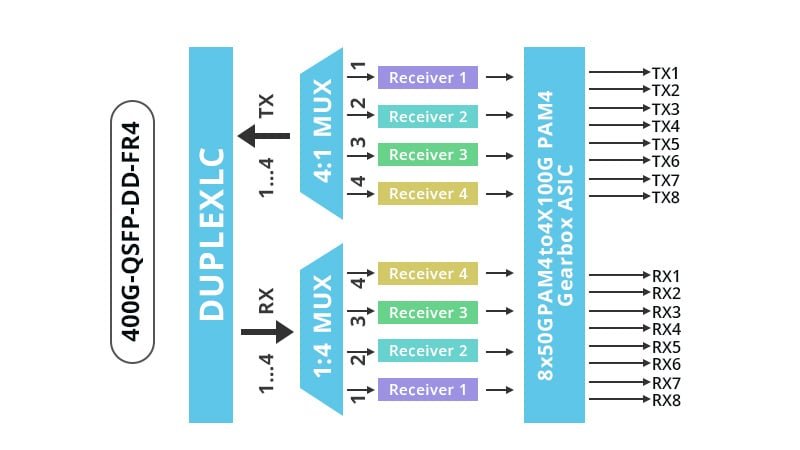
QSFP-DD is the latest generation Fiber Transceiver standard. It implements a double-density design by adding a second row of electrical contacts, supporting transmission rates up to 400G while maintaining backward compatibility with QSFP28/QSFP+.
Breakthrough Features:
● Eight-channel design, supporting 200G/400G speeds
● Fully backward compatible with the QSFP family
● Higher port density, saving rack space
● Supports emerging 200GbE and 400GbE standards
For enterprises preparing to deploy next-generation networks, Op2Link’s cutting-edge QSFP-DD transceiver offers a complete selection from 200G to 400G, helping customers smoothly transition to the ultra-high-speed network era.
Comparison of SFP, SFP+, SFP28, QSFP+, QSFP28, QSFP-DD Fiber Transceiver
To facilitate comparison of the core differences between these Fiber Transceivers, here is a summary of their key technical parameters:
| Module Type | Standard Specification | Data Rate | Channel Count | Typical Connector | Primary Application Scenarios |
|---|---|---|---|---|---|
| SFP | IEEE 802.3, SFF-8472 | Up to 1.25 Gbps | 1 | LC, RJ45 | Gigabit Ethernet, Enterprise Networks |
| SFP+ | IEEE 802.3ae, SFF-8431 | 10 Gbps | 1 | LC, RJ45 | 10G Ethernet, Data Center Access Layer |
| SFP28 | IEEE 802.3by, SFP28 MSA | 25 Gbps | 1 | LC | 25G Ethernet, 5G Fronthaul Networks |
| QSFP+ | IEEE 802.3ba, QSFP+ MSA | 40 Gbps (4×10G) | 4 | MPO, LC | 40G Ethernet, Data Center Aggregation Layer |
| QSFP28 | IEEE 802.3bm, QSFP28 MSA | 100 Gbps (4×25G) | 4 | MPO, LC | 100G Ethernet, Data Center Core Layer |
| QSFP-DD | QSFP-DD MSA, IEEE 802.3 | 200/400 Gbps | 8 | MPO, CS, LC | 200G/400G Ethernet, Hyperscale Data Centers |
These parameters reflect several key trends in Fiber Transceiver technology development: increased speed, higher density, and optimized power consumption. Notably, the SFP series maintains a single-channel design, while the QSFP series achieves higher bandwidth through multi-channel parallel transmission.
Key Differences and Compatibility of SFP, SFP+, SFP28, QSFP+ and QSFP28
Differences between Fiber Transceivers are not only reflected in speed and channel count; compatibility is also a critical factor to consider in actual deployments.
Regarding Form Factor and Compatibility, SFP, SFP+, and SFP28 share the same physical dimensions, but have different electrical interfaces and protocols. An SFP+ port can typically be downward compatible with an SFP module, but the speed will be limited to 1Gbps. An SFP28 module can be physically inserted into an SFP+ port, and vice versa, but the link will operate at the lower speed.
Within the QSFP series, QSFP+ and QSFP28 share the same form factor, but have different electrical interface speeds. The QSFP-DD module is slightly longer than QSFP28 (89.4mm vs. 72.3mm), primarily to accommodate the additional electrical channels.
Backward Compatibility is an important consideration in Fiber Transceiver design. QSFP-DD ports are designed with backward compatibility in mind, supporting the use of QSFP28, QSFP56, and QSFP+ transceivers. This design protects users’ existing investments and enables smoother network upgrades.
In terms of electrical channels, the SFP series is a single-channel design, QSFP+ and QSFP28 are quad-channel designs, and QSFP-DD upgrades to an eight-channel design. The increase in channel count directly brings higher total bandwidth but also places greater demands on module design, power management, and heat dissipation.
Applications and Selection Guide
Faced with diverse Fiber Transceiver choices, correct selection requires consideration of network requirements, cost-effectiveness, and future scalability.
Enterprise Office Networks typically do not have high bandwidth demands but require stable and reliable connections. 1G SFP transceivers are an ideal choice for such environments, offering high cost-effectiveness and mature technology. For enterprise data centers or storage networks, 10G SFP+ transceivers provide a good balance.
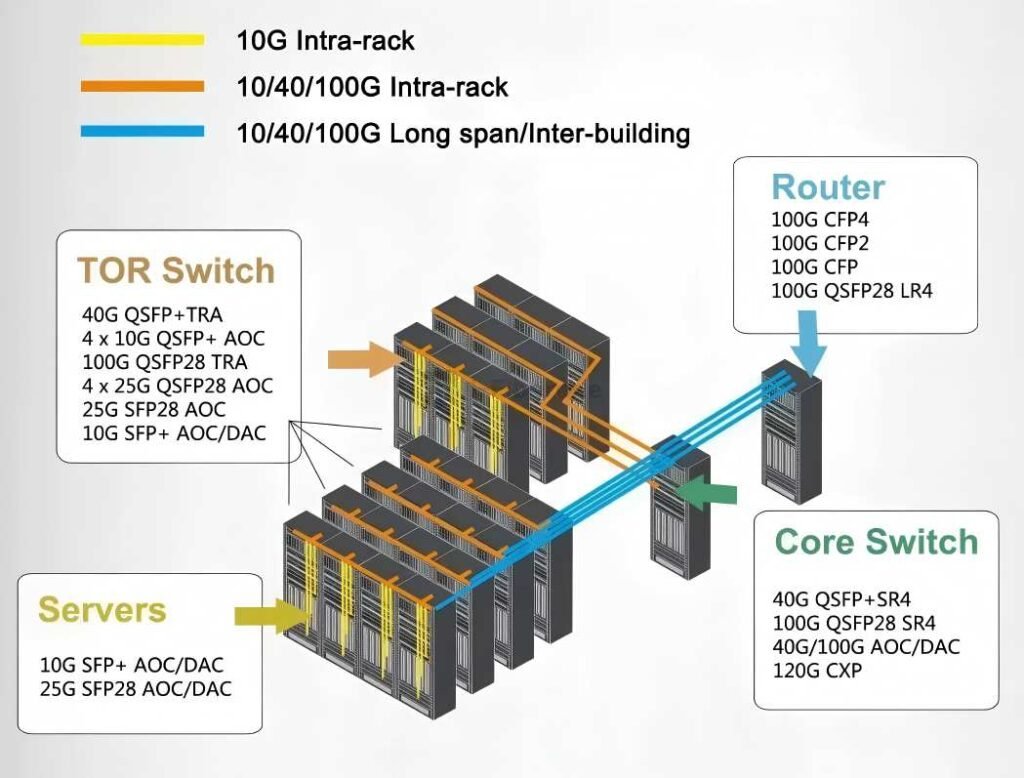
In Small to Medium-sized Data Centers, the access layer can utilize 25G SFP28 transceivers, while the aggregation layer uses 100G QSFP28 transceivers. This architecture meets performance needs while controlling overall costs. 25G technology provides a smooth upgrade path from 10G to 100G.
For Large or Hyperscale Data Centers, high density and high bandwidth are key considerations. 400G QSFP-DD transceivers have become the preferred choice for new data center builds. Their backward compatibility allows for gradual upgrades, reducing initial investment pressure.
When upgrading networks, compatibility verification is essential. While physical interfaces may match, protocol support and speed negotiation must be ensured. Consulting the compatibility list provided by the equipment manufacturer is the most reliable method.
Considering future expansion, choosing transceivers that support Breakout functionality can enhance network design flexibility. For example, a single QSFP-DD port can be split into multiple lower-speed connections to accommodate different device connectivity needs.
Op2Link Fiber Transceiver Product Selection Guide
| Your Network Needs | Recommended Module Type | Fibermart Product Series | Typical Application Scenarios |
|---|---|---|---|
| 1G/2.5G Network Connections | SFP | SFP Fiber Transceivers | Enterprise office networks, surveillance systems, legacy data center interconnects |
| 10G Network Upgrade | SFP+ | SFP+ transceivers | Server connections, campus backbone, 10G Ethernet |
| 40G Data Center Interconnect | QSFP+ | QSFP+ Solutions | Data center spine-leaf architecture, high-performance computing clusters |
| 100G Core Network | QSFP28 | QSFP28 Solutions | Cloud data center core layer, telecom backbone, large enterprise networks |
| 200G/400G Cutting-edge Deployment | QSFP-DD | QSFP-DD Product Line | Hyperscale data centers, AI/ML compute networks, 5G transport networks |
Whether you need standard SFP transceivers or the latest QSFP-DD solutions,Op2LinK offers a full range of high-quality Fiber Transceivers. All products undergo rigorous testing to ensure compatibility with mainstream networking equipment. Our expert technical team can provide personalized product selection advice and deployment guidance based on your specific application scenarios.
Frequently Asked Questions FAQs
Are SFP and SFP+ the same?
No. They share the same physical dimensions, but SFP supports 1G, while SFP+ supports 10G.
Can I use an SFP transceiver in an SFP28 port?
Yes, you can. SFP28 ports are backward compatible with SFP transceivers and cables. However, it is important to note that while SFP transceivers and cables can be inserted into an SFP28 port, they do not support the higher 25Gb/s data transfer rate of the SFP28 standard.
Is multimode fiber no longer usable for 400G networks?
Essentially, yes. Single-mode fiber dominates for distances beyond 100 meters due to lower modal dispersion. For example, QSFP-DD 400G-DR4 uses single-mode fiber only.
What are typical applications for QSFP28?
QSFP28 transceivers are primarily used for 100G data center spine-leaf connections, 5G transport networks, core/aggregation links, and breakout connections to 4×25G servers.
Does QSFP28 support 10G?
Yes, QSFP28 transceivers can support 10G connections using 4 lanes of 10GbE. However, it’s important to note that traditional QSFP+ transceivers also support 40G connections using 4 lanes of 10GbE.
Is QSFP-DD the preferred form factor for 400G deployment?
Yes, QSFP-DD is the preferred choice for 400G deployment. However, the specific choice depends on the application scenario. Skipping the 200G transition phase and directly adopting 400G may yield long-term cost savings. Yet, if budget constraints or operational concerns exist, a 200G transition phase can offer both initial cost savings and long-term operational benefits.