DESCRIPTION
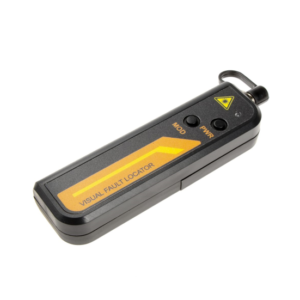
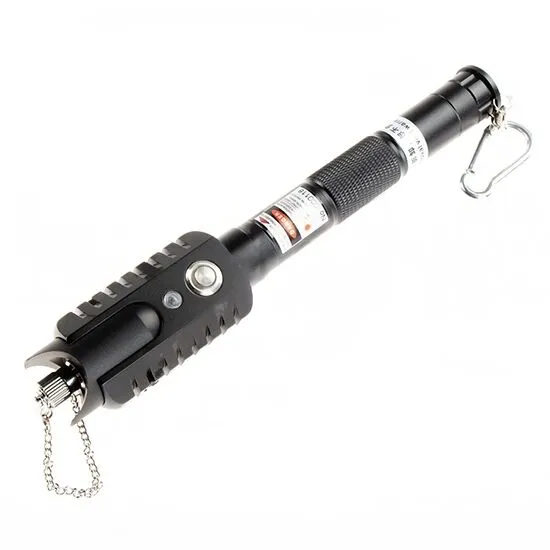
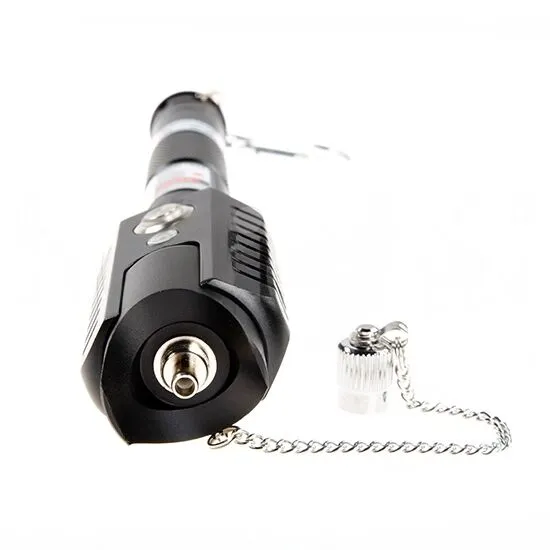
The HTO9V24 Visual Fault Locator is a versatile tool designed to locate faults, bends, and poor connections in optical fibers. With a 650 nm visible laser and options for continuous wave (CW) or pulsed operation, it provides clear and accurate detection over distances up to 40+ km (50 mW model). This VFL is ideal for telecom, CATV, and fiber optic labs, offering compatibility with standard 2.5mm connectors and optional adapters for LC interfaces. Built with a durable aluminum alloy shell and advanced heatsink design, it’s rugged enough for field use and ensures stable performance under varied conditions.
Engineering Suitability & Selection Boundaries
- When This Product Is the Right Choice
- Typically suitable when fault tracing needs a brighter visible output across longer spans, and the team can consistently follow laser safety practices during use.
- Commonly fits workflows standardized around 2.5mm ferrule interfaces (SC/FC/ST), where the tool can be used without frequent interface changes.
- Usually helpful when technicians benefit from switching between continuous and pulsed operation to adapt to different visibility conditions during on-site checks.
- Often selected where a rugged handheld form factor is required and the tool is expected to be carried and used repeatedly across field and lab routines.
- Typically works well when users already maintain a habit of cleaning connector end faces before testing, to reduce misleading results from contamination-related light leakage.
- When This Product May NOT Be Suitable
- May not be suitable when the site cannot support Class 3B laser handling controls (e.g., restricted areas, shared spaces, or strict safety compliance constraints).
- May not be appropriate if day-to-day work is primarily LC/MU and the workflow is not set up to manage optional adapter dependence consistently.
- Often not the best fit when tasks are mainly short-distance patch-level checks, where high-output variants add operational constraints without clear troubleshooting benefit.
- May be less suitable when teams need a single fixed behavior and prefer to avoid mode/frequency selection, which can vary results and operator interpretation across technicians.
- Common Selection Mistakes to Avoid
- Selecting a higher-output variant by default for every job, rather than matching output level to the troubleshooting distance and the site’s safety procedures.
- Assuming “universal connector support” means native LC/MU use, without planning for the optional adapter and its availability in the field kit.
- Using pulsed operation as a general default without team alignment, which can lead to inconsistent interpretation between technicians across sites.
- Skipping basic handling routines (e.g., leaving batteries installed during long storage, or testing with dirty end faces), which commonly causes interruptions or misleading fault indications.
Feature Details
- Accurate Fault Detection: Locates breaks, bends, and poor connections with a bright 650 nm laser.
- Versatile Operation: CW mode for steady tracing and pulsed mode (2Hz–9Hz) for better visibility in bright environments.
- Durable Design: Crash-proof, dust-proof, and resistant to electrostatic discharge (ESD) damage.
- Wide Compatibility: Universal 2.5mm connector supports SC, FC, and ST interfaces; adapters available for LC connectors.
- Long Detection Range: Output power options from 5 mW (5 km) to 50 mW (>40 km) meet various network testing needs.
Product Specifications
| Category | Specification |
| Central Wavelength | 650 nm ± 10 nm (635 nm available on request) |
| Emitter Type | FP-LD |
| Output Power Options | 5 mW (≥5 km), 10 mW (≥10 km), 20 mW (≥20 km), |
| 30 mW (≥30 km), 40 mW (>35 km), 50 mW (>40 km) | |
| Connector | 2.5mm universal (adapters for 1.25mm LC available) |
| Operating Modes | Continuous Wave (CW) and Pulsed |
| Pulse Frequency | 2 Hz–3 Hz (slow), 9 Hz (fast) |
| Power Supply | 2 × AA alkaline batteries |
| Operating Temperature | -20°C to 60°C |
| Storage Temperature | -40°C to 85°C |
| Dimensions | 22 × 3.5 × 2.6 cm |
| Weight | 155 g (without battery) |
Application Details
- Telecom and CATV Maintenance: Quickly locate faults in fiber networks for fast repair.
- Fiber Labs and Testing Facilities: Perform precise measurements for fault location and connection quality.
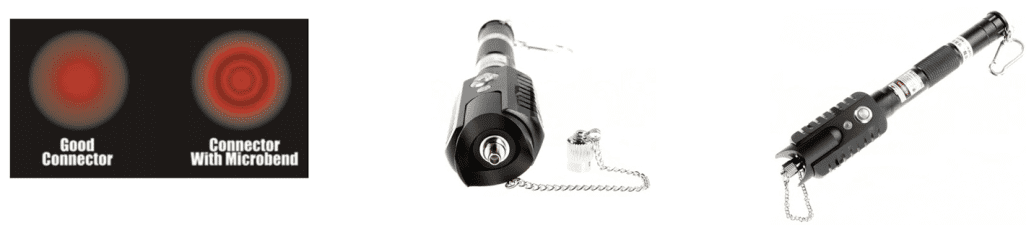
- Connector Inspection: Detect hidden microbends and poor gluing in connectors.
- End-to-End Fiber Identification: Identify specific fibers with a bright, visible laser output.
Packing List
- 1 × Visual Fault Locator (HTO9V24)
- 1 × Carrying Pouch
- 1 × User Guide
Tips for Use
- Remove batteries when not in use to prevent leakage.
- Clean fiber heads before operation for optimal performance.
- For LC/MU connectors, an optional adapter is required.
FAQ
Q1: What is the maximum output power?
Up to 50 mW, suitable for long-distance testing.
Q2: How far can it detect faults?
Up to >40 km (50 mW model), depending on fiber condition.
Q3: Is it suitable for outdoor telecom use?
Yes, its high power and durable housing make it ideal for OSP networks.
Q4: What connectors are supported?
2.5mm universal ferrule interface.
Q5: Does it include multiple test modes?
Yes, continuous and pulse modes.
Q6: Is there risk of laser damage?
Users should follow Class 3B laser safety precautions.
Q7: Can it detect microbends?
Yes, high power makes microbend leakage more visible.