DESCRIPTION
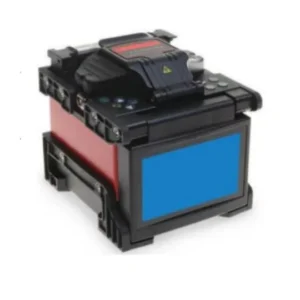
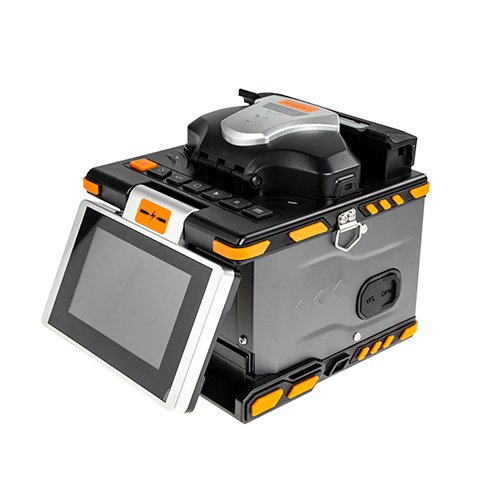
The M5 Fiber Optic Fusion Splicer is an intelligent, fully automatic fusion tool engineered for fast, accurate, and reliable splicing of SMF, MMF, DSF, and NZDSF fibers. With a 6-motor core alignment system, the M5 ensures low splice loss, higher efficiency, and precise positioning compared to traditional 4-motor models.
Designed for field engineers, telecom operators, and fiber optic contractors, this model integrates built-in VFL and Optical Power Meter (OPM), GUI operation interface, and data logging of up to 10,000 splices and 1,000 images. Whether you’re handling dense network deployment or field repairs, the M5 brings the power of speed, precision, and durability to your toolkit.
Engineering Suitability & Selection Boundaries
- When This Product Is the Right Choice
- Typically suitable when splicing work involves multiple fiber categories (e.g., SMF/MMF/DSF/NZDSF) and consistency across jobs is important.
- Commonly selected when the job requires core/cladding alignment control rather than basic alignment approaches, especially for higher-sensitivity link budgets.
- Usually a good fit when field workflows benefit from built-in VFL and OPM for immediate continuity/power verification without switching devices mid-task.
- Typically appropriate when crews need to handle a range of fiber cladding and coating sizes using a universal clamp approach, and want one tool to cover common site variations.
- Commonly used when teams value splice record and image traceability for later review, reporting, or repeat-job consistency.
- Often suitable when work happens away from mains power and a battery-driven workflow is needed, provided charging and storage handling can be managed.
- When This Product May NOT Be Suitable
- May not be appropriate when the operating environment frequently falls outside the stated temperature/humidity limits, or where condensation is common in the work area.
- Typically less suitable when teams cannot keep a routine for electrode condition management (lifecycle, contamination control, timely replacement), since performance may drift with usage.
- May not be suitable when the required fiber diameter ranges fall outside the supported cladding/coating window, as setup and clamp stability may not match the intended use.
- Often not ideal when the work process requires strictly standardized external test instrumentation, and the site policy does not allow mixing verification steps with integrated tools.
- May be less suitable when long sessions require high duty-cycle operation but the team cannot control battery storage temperature and charge discipline, which commonly impacts field readiness.
- Common Selection Mistakes to Avoid
- Treating “supports multiple fiber types” as meaning one fixed setup fits all—different fiber categories commonly require different process settings and verification habits.
- Using the built-in OPM as a “final pass/fail” result without keeping a consistent routine for wavelength selection and reference handling, which may reduce comparability across crews.
- Assuming VFL visibility alone confirms splice quality—VFL is typically for continuity/fault visibility, not a complete indicator of loss behavior across scenarios.
- Skipping basic handling discipline (cleanliness, stable placement, controlled closing/locking steps), which commonly increases variability even when alignment is automated.
- Neglecting to export/organize stored records, leading to “data exists but can’t be used” during troubleshooting reviews or repeated deployment phases.
Product Specifications
| Parameter | Details |
| Applicable Fibers | SMF (G.652), MMF (G.651), DSF (G.653), NZDSF (G.655) |
| Fiber Diameter | Cladding: 80–150μm; Coating: 0.1–3mm |
| Splice Loss | SMF: 0.02dB, MMF: 0.01dB, DSF/NZDSF: 0.04dB |
| Alignment Method | Core and cladding alignment |
| Focusing Method | 6-motor automatic focusing |
| Welding Time | 8 seconds (typical SMF) |
| Heating Time | Typical: 18 seconds; Range: 0–60 seconds |
| Screen | 5.5″ capacitive LCD touch screen (180° flip) |
| Magnification | 300x (X/Y); 150x (synchronized X/Y) |
| Storage Capacity | 10,000 fusion records + 1,000 images |
| Electrode Life | 3,000 uses |
| Illumination | LED light; automatic/manual |
| Clamp Type | Universal three-in-one (bare, patch, leather) |
| Battery Capacity | 5200mAh; Supports 200 fusion + heating cycles |
| Charging Time | ≤3.5 hours |
| Power Supply | Input: AC100-240V 50/60Hz; Output: DC13.5V/4A |
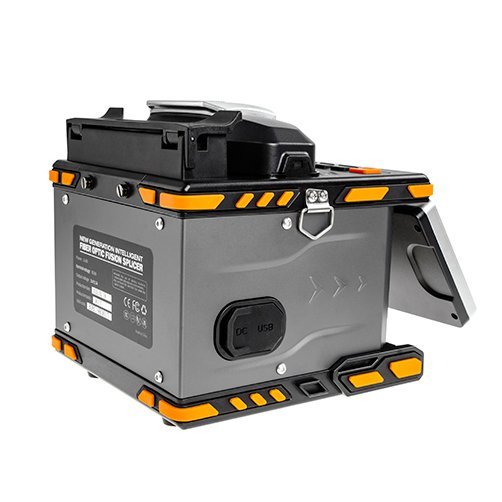
| USB Output | 5V/500mA |
| Wavelength Range (OPM) | 850–1625nm |
| Power Measurement Range (OPM) | -70 ~ +3 dBm; Uncertainty: ±0.5% |
| Red Light Source (VFL) | ≥10mW |
| Device Size (mm) | 156 × 155 × 152 mm |
| Toolbox Size (mm) | 342 × 280 × 187 mm |
| Weight (Bare Metal) | 1.74 kg (with battery) |
| Total Weight | 4.7 kg |
| Working Temperature | -15°C to +50°C |
| Humidity Tolerance | ≤95% RH (non-condensing) |
| Storage Temperature | -40°C to +80°C |
| Battery Storage Temp. Range | -20°C to +30°C |
Feature Details

- Six-Motor Core Alignment: Delivers precise micro-adjustments, minimizing splice loss and boosting overall splicing speed.
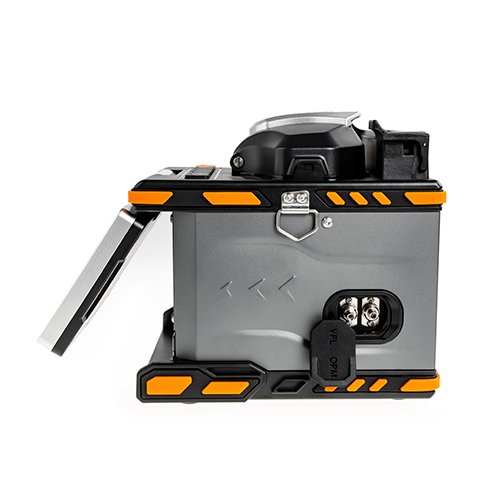
- Dual Testing Function: Built-in Visual Fault Locator (VFL)and Optical Power Meter (OPM) allow immediate inspection and signal verification without external tools.
- Smart GUI Interface: Intuitive touch-based navigation with multilingual support and user-friendly weld setting configurations.
- High Storage Capacity: Stores up to 10,000 fusion records and 1,000 images for future tracking and export.
- Three-in-One Clamp: Handles a variety of fiber types—bare, patch, or leather—with firm fixation and stable operation.
Application Details
- Fiber Network Construction: Reliable for long-distance splicing in telecom backbone and metro access networks.
- FTTH/FTTX Projects: Quick fusion for drop cables and premise wiring.
- On-Site Emergency Repair: Fast setup and rapid fusion for field service teams.
- Cable TV and LAN Installations: Ideal for multi-mode and single-mode fiber environments.
- Training and Demo Purposes: High-performance device suited for professional training centers and workshops.
Additional Information
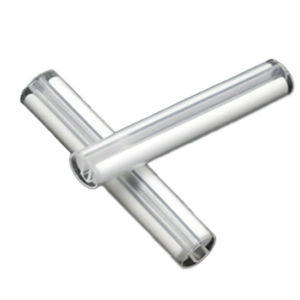
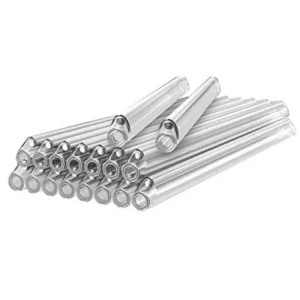
- Supported Heat-Shrink Tubes: 20mm / 30mm / 40mm / 50mm / 60mm
- Data Export: USB support for fusion records and firmware upgrades
- Energy-Saving Mode: Auto power-off and power-saving functionality
- Rental Mode: Ideal for service providers and equipment resellers
- Optional Accessories: Covered wire stripper, additional electrodes, language customization
Standard Accessories

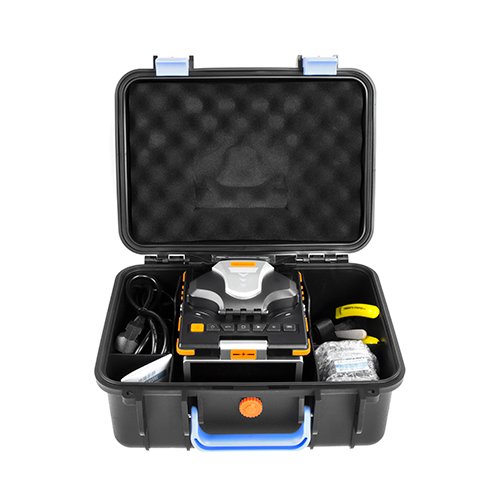
✔ Fusion Splicer
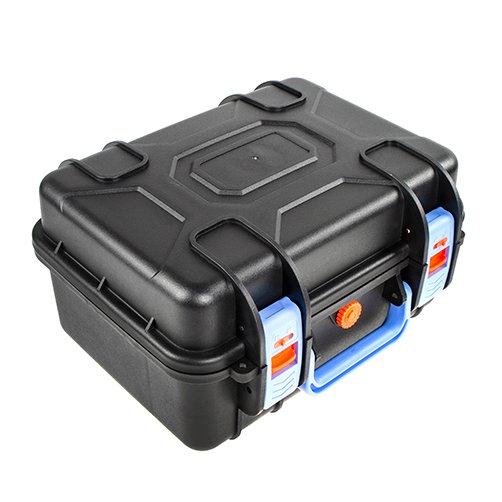
✔ Toolbox
✔ Optical Fiber Cleaver
✔ Miller Clamp
✔ Wire Stripper (optional)
✔ Calibration Fiber
✔ Paintbrush
✔ Power Adapter
✔ Shoulder Strap (x2)
✔ User Manual
✔ Certificate + Warranty Card
FAQ
Q1: What alignment method does M5 use?
Core alignment with 6 motors for high-precision fiber positioning.
Q2: Does the M5 include built-in test tools?
Yes, it integrates both a Visual Fault Locator (VFL) and Optical Power Meter (OPM).
Q3: What is the typical splice time?
Around 7–9 seconds depending on fiber type.
Q4: Can it splice different fiber types?
Yes, SM, MM, DS, and NZDS fibers.
Q5: What is the battery capacity?
Usually supports 200+ splice and heat cycles on a single charge.
Q6: Does it support SOC connectors?
Yes, compatible with splice-on connectors.
Q7: Is it suitable for outdoor FTTH deployment?
Yes, rugged housing and strong windproof screen.