
Table of Content
- Core Definitions and Structural Principles
- What Is a Single Mode Fiber Pigtail?
- What Is a Multimode Fiber Pigtail?
- Key Structural Differences Between Single Mode vs Multimode Fiber Pigtail
- Performance Comparison: Distance, Bandwidth, Loss, and Stability
- Transmission Distance
- Bandwidth Capacity
- Transmission Loss and Stability
- Service Life and Environmental Adaptability
- Cost Analysis: Initial Investment and Total Cost of Ownership
- Component Cost
- Deployment and Maintenance Cost
- Total Cost of Ownership (TCO)
- Typical Application Scenarios
- Recommended Scenarios for Single-Mode Fiber Pigtails
- Recommended Scenarios for Multimode Fiber Pigtails
- How to Choose Based on Scenario: Single Mode vs Multimode Fiber Pigtail
- Connector Types and Compatibility
- Common Connector Types
- Compatibility Principles
- Installation, Use, and Maintenance Specifications
- Installation Requirements
- Daily Maintenance
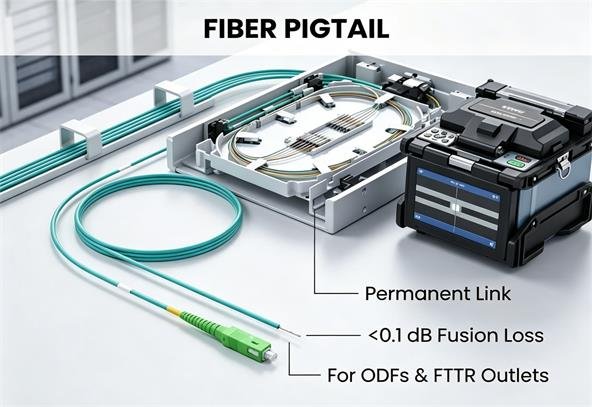
In modern optical communication systems, fiber pigtails serve as critical bridging components that connect optical fibers to active equipment, passive distribution frames, and other optical links. A fiber pigtail is a short-length optical fiber cable with one end pre-terminated with a polished connector and the other left as a bare fiber, which is fusion-spliced to the backbone fiber cable to achieve low-loss, high-stability optical signal transmission.
With the rapid development of data centers, 5G communication, fiber-to-the-home (FTTH), and enterprise campus networks, the selection between Single Mode vs Multimode Fiber Pigtail has become a core decision that directly affects network performance, transmission distance, deployment cost, and long-term scalability. Many engineers, purchasers, and network planners face confusion when choosing between these two types, as mismatched selection can lead to signal attenuation, insufficient bandwidth, wasted investment, or even network failure.
This article provides a comprehensive, professional analysis of single-mode and multimode fiber pigtails from the perspectives of structural principles, transmission performance, cost differences, application scenarios, installation specifications, and selection strategies. It aims to help readers accurately determine which fiber pigtail type best matches their project requirements.
Core Definitions and Structural Principles
What Is a Single Mode Fiber Pigtail?
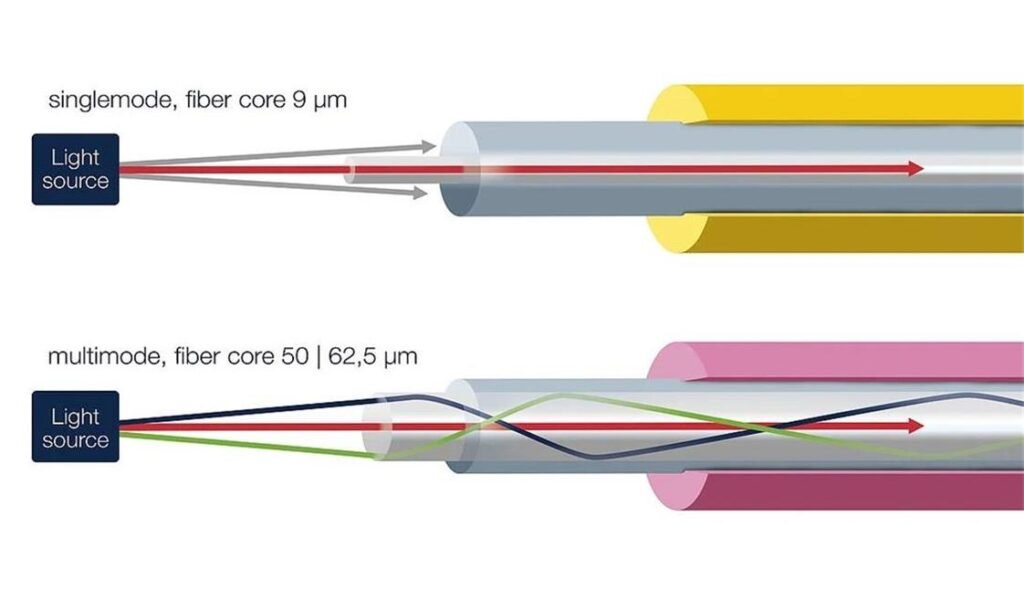
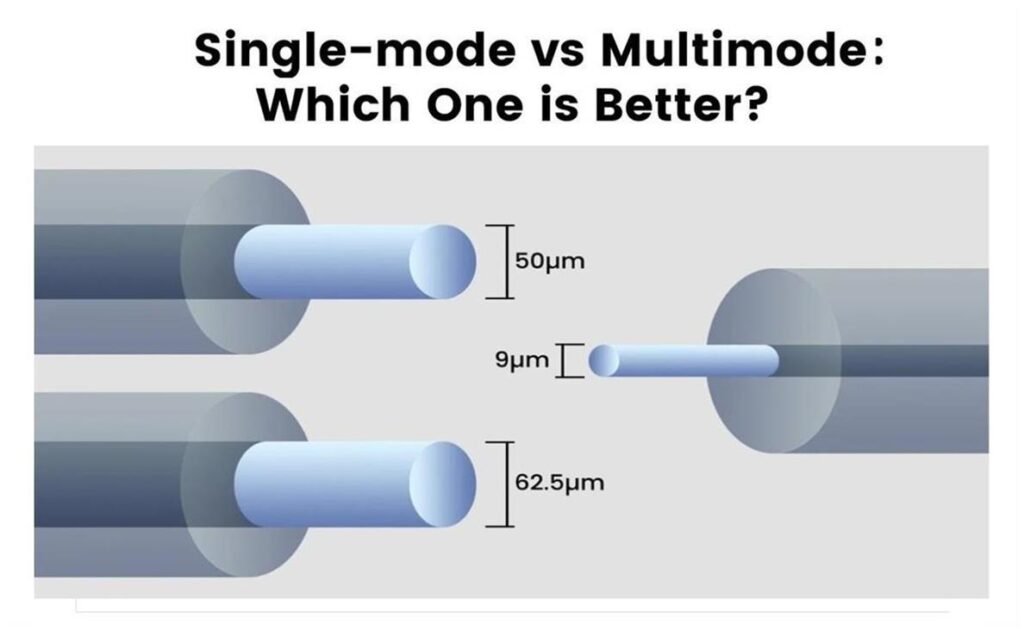
A single-mode fiber pigtail (SM) uses an optical fiber with an extremely small core diameter, typically 9/125 μm (9 μm core, 125 μm cladding). Its structural design allows only one fundamental mode of light to propagate along the fiber axis, eliminating modal dispersion—the primary factor limiting transmission distance and bandwidth in multimode fibers. Single-mode fiber pigtails generally use laser diodes (LD) or distributed feedback (DFB) lasers as light sources, operating at 1310 nm or 1550 nm wavelengths, which feature low transmission loss and strong anti-interference capabilities.
What Is a Multimode Fiber Pigtail?
A multimode fiber pigtail (MMF) has a significantly larger core diameter, available in 50/125 μm (OM3/OM4/OM5) or 62.5/125 μm (OM1/OM2) specifications. The large core allows multiple light modes to propagate simultaneously, but these modes travel at different speeds and paths, resulting in modal dispersion that shortens effective transmission distance and limits bandwidth improvement. Multimode fiber pigtails are usually matched with LED or VCSEL (Vertical-Cavity Surface-Emitting Laser) light sources, operating at 850 nm wavelength, which are low-cost and easy to couple.
Key Structural Differences Between Single Mode vs Multimode Fiber Pigtail
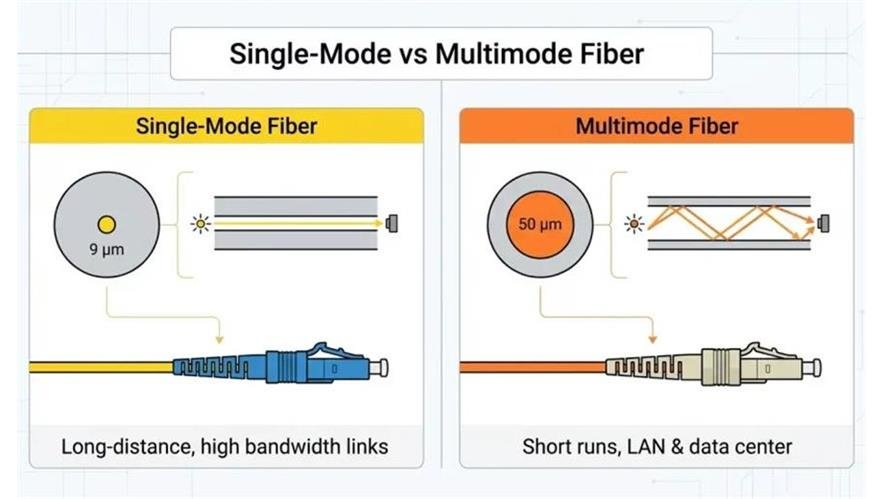
The core difference between Single Mode vs Multimode Fiber Pigtail lies in core diameter and light propagation mechanism, which determine all subsequent performance differences: – Single-mode: 9 μm core, single-mode propagation, almost no modal dispersion, long transmission distance, high bandwidth. – Multimode: 50/62.5 μm core, multi-mode propagation, obvious modal dispersion, short transmission distance, relatively low bandwidth. – Both share the same 125 μm cladding diameter and can use the same connector types (LC, SC, FC, ST, MPO), but cannot be mixed arbitrarily with optical modules.
Performance Comparison: Distance, Bandwidth, Loss, and Stability
Transmission Distance
Single-mode fiber pigtails support ultra-long-distance transmission, ranging from hundreds of meters to tens of kilometers or even farther. In 10Gbps systems, they can stably reach 40 km without relay amplification, meeting the needs of backbone networks and cross-regional links.
Multimode fiber pigtails are limited by modal dispersion and are only suitable for short-distance transmission. Under 10Gbps, OM3/OM4 multimode supports a maximum of 300–550 m, making it ideal for intra-building, data center, and campus LAN connections.
Bandwidth Capacity
Single-mode fiber pigtails have essentially unlimited bandwidth potential and can easily support 10G, 40G, 100G, 400G, and even 800G+ high-speed protocols, making them the preferred choice for long-distance high-speed transmission and future-oriented networks.
Multimode fiber pigtails have relatively low bandwidth, affected by modal dispersion. Although OM4/OM5 has improved performance, it is still mainly used for short-distance high-speed connections within data centers, with bandwidth far lower than single-mode under the same distance.
Transmission Loss and Stability
Single-mode fiber pigtails have extremely low loss (0.3–0.4 dB/km at 1310 nm, 0.2–0.3 dB/km at 1550 nm), stable signal transmission, strong resistance to electromagnetic interference, and high reliability in complex environments.
Multimode fiber pigtails have higher loss (about 2–3 dB/km), and modal dispersion causes signal distortion to increase with distance, making them unsuitable for long-distance or high-standard transmission scenarios.
Service Life and Environmental Adaptability
Single-mode fiber pigtails have a simple structure, good high-temperature resistance, and strong stability in harsh environments such as outdoors, high humidity, and strong interference, with a service life of more than 25 years.
Multimode fiber pigtails are mostly used in indoor, controlled environments, with relatively weak environmental tolerance and shorter service life under extreme conditions.
Cost Analysis: Initial Investment and Total Cost of Ownership
Component Cost
The price of Single Mode vs Multimode Fiber Pigtail itself is not significantly different, but the matching optical modules show a huge gap: multimode modules are cheaper, while single-mode laser modules cost 2–5 times more.
For large-scale projects, the cost difference in modules is far greater than that of pigtails, so budget planning must consider the entire link cost.
Deployment and Maintenance Cost
Multimode fiber pigtails have low coupling requirements, easy construction, low equipment costs, and low short-distance deployment expenses, suitable for projects with limited budgets and short transmission distances.
Single-mode fiber pigtails require high-precision alignment and professional construction, with slightly higher deployment costs, but they save relay equipment costs in long-distance scenarios and have lower long-term maintenance costs.
Total Cost of Ownership (TCO)
Short-distance scenarios (within 500 m): multimode solutions have obvious cost advantages, with lower TCO. Long-distance scenarios (exceeding 500 m): single-mode solutions reduce relay and upgrade costs, and TCO is more competitive. Long-term evolution (400G+): single-mode has stronger compatibility, avoiding repeated investment caused by network upgrades.
Typical Application Scenarios
Recommended Scenarios for Single-Mode Fiber Pigtails
Single-mode fiber pigtails are suitable for long-distance, high-bandwidth, and high-reliability requirements:
● Telecom operator backbone networks, metropolitan area networks (MAN), and long-distance transmission links.
● Data center interconnection (DCI), cross-city, cross-campus disaster recovery connections.
● 5G base station fronthaul and backhaul networks, supporting high-speed, low-latency signal transmission.
● FTTH, CATV, and other optical access networks requiring long-distance coverage.
● High-speed scientific research networks, aerospace, industrial control, and other harsh environments.
Recommended Scenarios for Multimode Fiber Pigtails
Multimode fiber pigtails excel in short-distance, high-density, cost-sensitive scenarios:
● Internal connections in data centers: servers, switches, storage devices, and cabinet-level links.
● Enterprise LAN, campus network, and intelligent building internal vertical/horizontal wiring.
● Industrial automation, laboratory equipment interconnection, and short-distance high-speed links.
● Fiber-to-the-desk (FTTD) in hospitals, finance, and other indoor scenarios with high bandwidth requirements.
How to Choose Based on Scenario: Single Mode vs Multimode Fiber Pigtail
● Distance > 500 m: choose single-mode without hesitation.
● Distance < 500 m, budget-sensitive, short-term use: choose multimode.
● Pursuing long-term evolution, 400G+/800G compatibility: choose single-mode.
● Outdoor, complex environment, high stability demand: choose single-mode.
● Indoor, high-density, short-distance, large-scale deployment: choose multimode.
Connector Types and Compatibility
Common Connector Types
Both single-mode and multimode fiber pigtails support LC, SC, FC, ST, MPO, and other connectors, with consistent appearance and size but different internal polishing and core matching standards.
Compatibility Principles
Single Mode vs Multimode Fiber Pigtail cannot be mixed with unmatched optical modules: single-mode pigtails must match single-mode modules, and multimode pigtails must match multimode modules; otherwise, severe signal attenuation or interruption will occur.
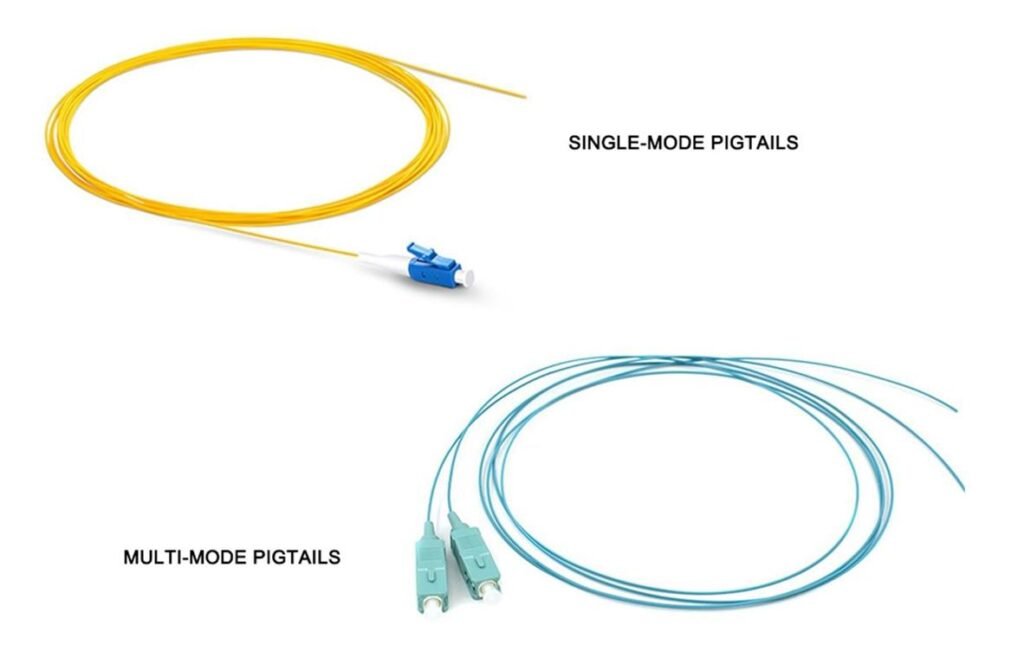
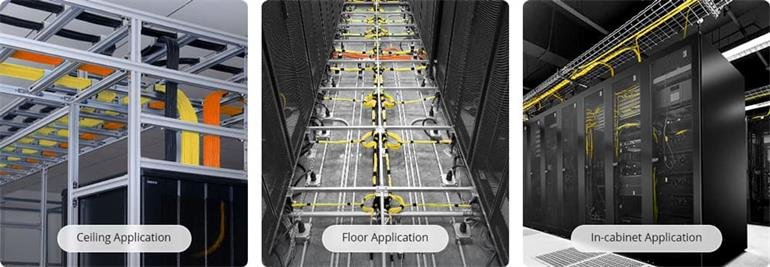
In wiring management, single-mode pigtails are usually yellow, and multimode pigtails are orange (OM1/OM2) or aqua (OM3/OM4/OM5), which is convenient for on-site identification and maintenance.
Installation, Use, and Maintenance Specifications
Installation Requirements
Single-mode fiber pigtails require high-precision fusion splicing and end-face polishing to avoid increasing loss caused by slight deviations. Construction personnel need professional certification and operation.
Multimode fiber pigtails have relatively low installation accuracy requirements, fast construction, and low difficulty, suitable for large-scale rapid deployment.
Daily Maintenance
Both types require avoiding excessive bending, stretching, and extrusion to prevent macro-bending and micro-bending losses. The connector end-face must be kept clean, and dust-proof caps should be used when not in use to avoid scratches or contamination.
Selection Guide: How to Determine the Right Fiber Pigtail
When choosing between Single Mode vs Multimode Fiber Pigtail, comprehensively evaluate the following five dimensions:
1. Transmission distance: core indicator—>500 m single-mode, <500 m multimode.
2. Bandwidth demand: 40G+ priority single-mode, 10G and below can choose multimode.
3. Budget level: short-distance limited budget multimode, long-distance no alternative single-mode.
4. Environment: outdoor/harsh environment single-mode, indoor stable environment multimode.
5. Future upgrade: long-term use and high-speed evolution single-mode, short-term use multimode.
Single Mode vs Multimode Fiber Pigtail each have clear technical positioning and application boundaries, and there is no absolute “better” but only “more suitable”.
Single-mode fiber pigtails feature long distance, high bandwidth, high stability, and strong future compatibility, serving as the core of long-distance and high-speed networks. Multimode fiber pigtails offer low cost, easy deployment, and high density, dominating short-distance scenarios such as data centers and enterprise LANs.
When selecting, accurately measure transmission distance, bandwidth requirements, budget, environment, and upgrade plans, and choose the corresponding fiber pigtail type to balance performance, cost, and reliability, ensuring efficient, stable, and long-term operation of the optical link.
For customized projects, it is recommended to communicate with professional optical fiber manufacturers to provide targeted solutions based on actual wiring topology, equipment types, and business needs, maximizing the value of fiber pigtail applications.