
Table of Content
- What Exactly is an AOC or Active Optical Cable?
- An Accessible Way to Understand the Differences of AOC, Fiber and Copper Cables
- What is Breakout AOC Cable?
- Advantages to Choose AOCs
- Why Choose AOC, but not DAC or Transceiver Module?
- How Are AOC Cables Used in Data Center?
- Scenario 1: Direct Switch-to-Switch Connectivity
- Scenario 2: Intra- and Inter-Rack Connectivity via Branching AOCs
- Scenario 3: Extended Distance Transmission
- Key Factors To Choose Appropriate AOC Cables
- Data Rate:
- Cable Length
- Reliability
- Price and Supplier Selection
- Market Considerations
- Key Application Areas of Active Optical Cables (AOCs)
- Op2Link AOC Cables Catagory
- 10G SFP+ AOC Cable
- 40G QSFP+ AOC Cable
- 25G/50G SFP56 AOC Cable
- 100G QSFP28 Cable
- 200G QSFP56 AOC Cable
- 400G QSFP-DD OSFP AOC Cable
- 800G OSFP QSFP-DD AOC Cable
- Conclusion
- FAQs
- How do active optical cables differ from ordinary fiber optic cables?
- Which devices can be connected using active optical cables?
- What should you check before buying active optical cables?
- What problems can active optical cables help you solve?
In the IT sector, “AOC” is frequently used to denote Active Optical Cables. Similar to our approach with Direct Attach Copper (DAC) cables, we believe it is important to address the fundamental question: “What is an AOC?” At Op2Link, we are committed to knowledge dissemination, and despite the familiarity of this topic among many readers, we have developed a concise guide for clarity.
What Exactly is an AOC or Active Optical Cable?
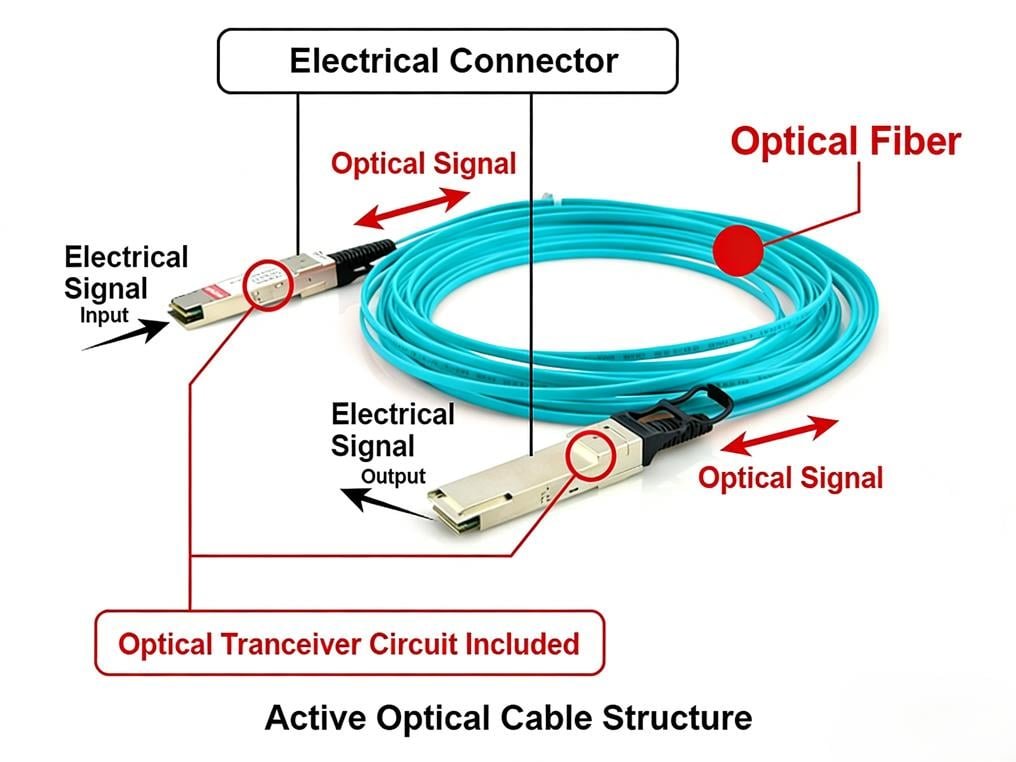
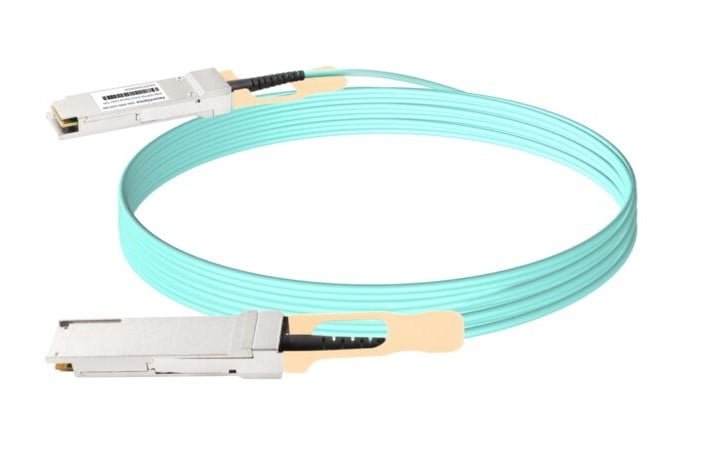
Active Optical Cables (AOCs) are fiber optic patch cables integrating optical transceivers at both terminations. Employing electro-optical conversion at each end, AOCs enhance transmission speed and distance while maintaining compatibility with standard electrical interfaces. The architecture of AOC cables, detailed in the following diagram, incorporates active electrical and optical components to amplify and receive fiber optic signals. This design has established AOCs as a prominent cabling solution within data center environments.
The current market offers a diverse selection of AOCs tailored for 10G/40G/100G applications, including but not limited to 10G SFP+ AOC, 25G SFP28 AOC, 40G QSFP+ AOC, 56G QSFP+ AOC, 40G QSFP+ to 4x SFP+ breakout AOC, 40G QSFP+ to 8x LC breakout AOC, 100G QSFP28 AOC, 100G QSFP28 to 4x SFP28 breakout AOC, and 120G CXP AOC. These AOC modules are commonly deployed for short-distance, multi-channel data communication and interconnection between devices, such as inter-rack connections, inter-shelf connections, storage devices, hubs, switches, routers, and servers.
An Accessible Way to Understand the Differences of AOC, Fiber and Copper Cables
Copper Cable: Transmits electrical signals, but is susceptible to signal attenuation and electromagnetic interference (EMI) over longer distances.
Fiber Optic Cable: Transmits data via light pulses, offering immunity to EMI and minimal signal loss, even across distances of several kilometers.
Active Optical Cable (AOC): A fully integrated, plug-and-play solution incorporating optical fibers and integrated transceivers (electrical-to-optical converters) within each connector, ensuring immediate operability without the need for separate transceivers.
What is Breakout AOC Cable?
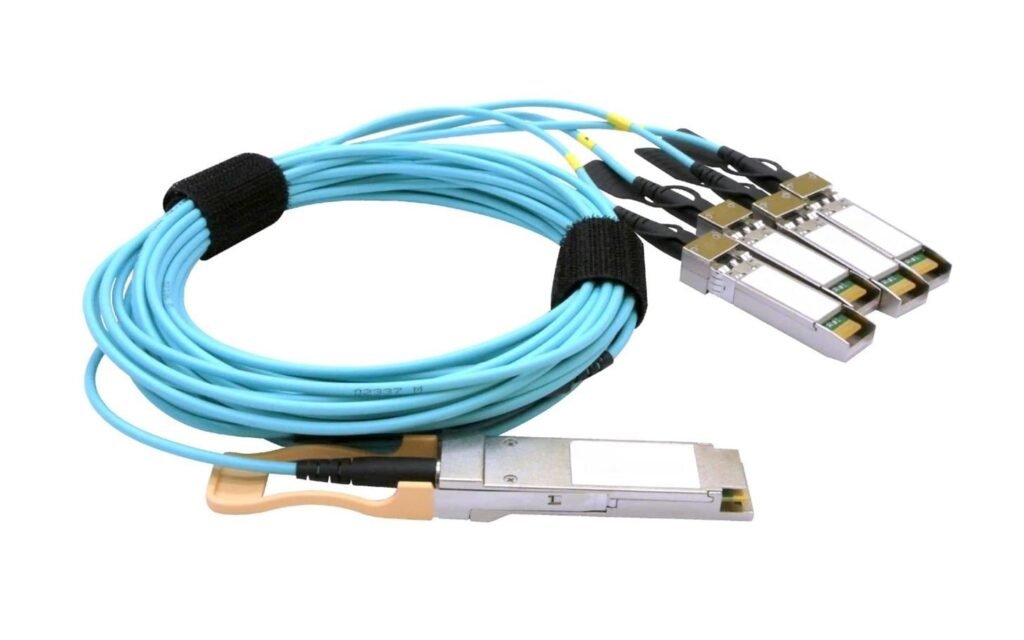
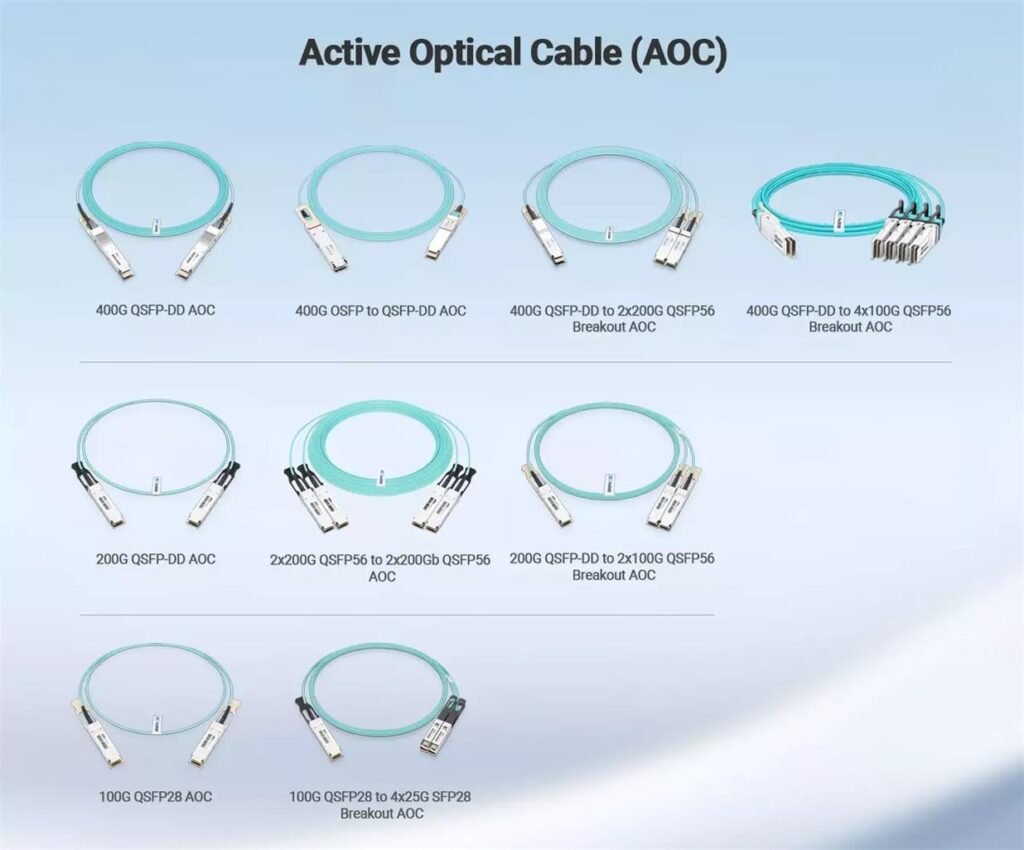
AOCs also encompass breakout configurations, offering notable advantages in network design. For instance, QSFP+ is employed in 40GbE networks, while QSFP28 is utilized in 100GbE networks; the “Q” signifies quad-channel architecture. Consequently, a QSFP+ connector can be interpreted as facilitating four SFP+ channels. Given SFP+’s 10Gbps transmission rate, QSFP+’s 40Gbps rate is achieved by aggregating four 10Gbps channels. This principle extends to SFP28 and QSFP28. A common deployment strategy involves leveraging high-density QSFP+/QSFP28 packaging for breakout connections to multiple lower-speed devices. A typical example is a connection from one QSFP28 (100GbE) port to four SFP28 (25GbE) ports.
It is crucial to acknowledge that breakout functionality is not universally supported across all network devices, including switches, routers, network cards, servers, and storage devices. While prevalent, exceptions exist. For example, the HPE 620QSFP28 4x 25GbE single-port QSFP28 Ethernet adapter is specifically designed to utilize its QSFP28/QSFP+ port with DAC/AOC cables or as four independent connections.
In this configuration, despite the single physical port, the network card operates as four discrete 25GbE interfaces, rather than a single 100GbE interface.
The primary benefit of breakout AOCs lies in their ability to perform optical signal splitting directly within the optical cable, eliminating the need for external optical splitters. This reduction in supplementary components represents a key economic driver for AOC adoption.
Advantages to Choose AOCs
Active Optical Cables (AOCs) address critical challenges in contemporary connectivity, establishing themselves as the superior solution for high-performance applications due to the following attributes:
Superior Bandwidth and Data Transfer Rates: AOCs are ideally suited for demanding applications such as 4K/8K video streaming, data center interconnects, and high-performance computing (HPC). They seamlessly accommodate industry standards including HDMI 2.1, DisplayPort 2.0, USB4, and InfiniBand.
Extended Transmission Distances: In contrast to passive copper cables, which exhibit limitations beyond 3 meters for high-speed signal transmission, AOCs facilitate reliable data transmission at maximum bandwidths across distances of 100 meters or more without signal degradation.
Reduced Weight and Enhanced Flexibility: The utilization of optical fibers results in significantly thinner and lighter cables compared to copper alternatives. This characteristic simplifies cable routing and management, particularly in confined spaces such as server racks.
Electromagnetic Interference (EMI) Immunity: Employing light-based transmission, AOCs are inherently immune to electromagnetic interference. This ensures stable, error-free connectivity, even within electromagnetically noisy environments.
Enhanced Data Security: The non-radiating nature of fiber optics provides a high degree of security, rendering them exceptionally difficult to intercept. This attribute is crucial for secure data center implementations.
Why Choose AOC, but not DAC or Transceiver Module?
To accommodate the escalating need for enhanced speed and performance in 10/40/100G transmission, a variety of solutions are available. This section will elucidate the specific benefits of active optical cables (AOCs) through a comparative analysis with direct attach cables (DACs) and fiber optic transceivers.
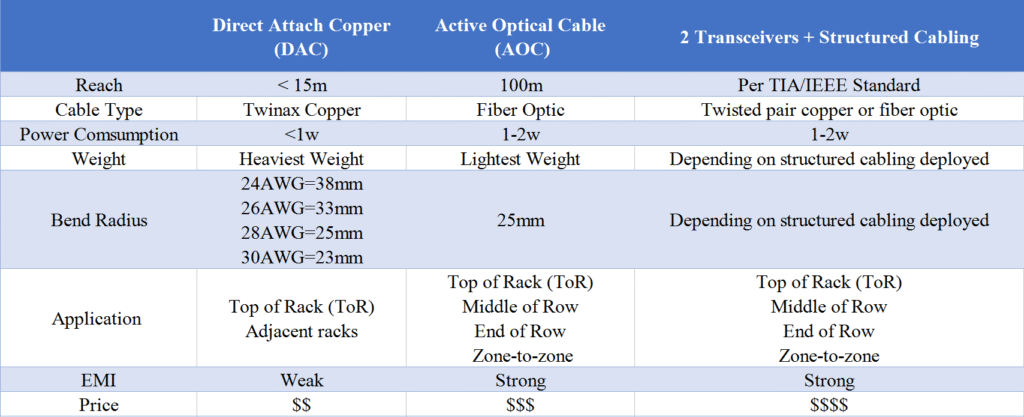
The following conclusions can be drawn from the data:
AOCs exhibit a lighter weight and smaller bending radius, facilitating improved cable management in high-density environments.
The reduced diameter of AOC cables optimizes space utilization and enhances airflow, thereby contributing to improved thermal management in densely packed systems.
AOCs present notable advantages over DACs, particularly in applications requiring transmission distances beyond 15 meters.
The high dielectric constant of the optical fibers incorporated in AOCs provides exceptional immunity to electromagnetic interference (EMI).
AOCs represent a cost-effective and versatile direct connection solution for short-distance interconnect systems (≤100m).
The factory pre-terminated nature of AOC connectors enhances their robustness and reduces the risk of damage associated with repeated insertion and removal during routine use. Furthermore, AOCs demonstrate enhanced reliability compared to traditional transceivers.
How Are AOC Cables Used in Data Center?
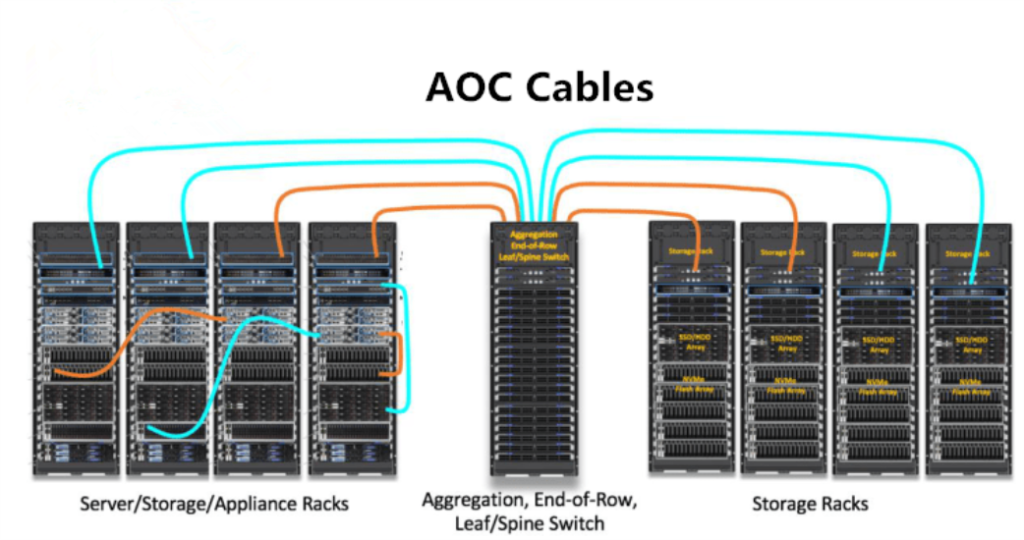
Active Optical Cables (AOCs) offer substantial performance advantages over traditional copper cables, making them a compelling choice for modern data center architectures. Leading hyperscale data center operators are increasingly adopting AOCs in lieu of copper solutions for 10G/25G server-side and 40G/100G switch fabric networks. AOCs present a cost-optimized solution for interconnecting top-of-rack (ToR) switches with end-of-row aggregation switches. Furthermore, AOCs extend connectivity between ToR switches and storage subsystems beyond the distance constraints of Direct Attach Copper (DAC) cables, which are typically limited to 3-7 meters. The following scenarios highlight typical AOC deployment models:
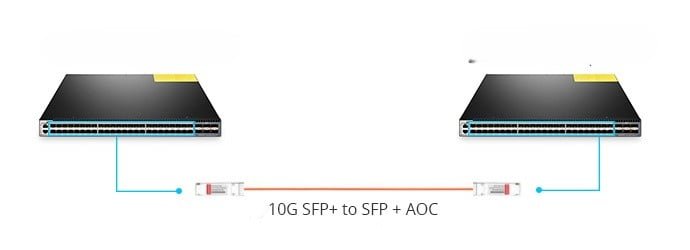
Scenario 1: Direct Switch-to-Switch Connectivity
A single AOC cable provides a direct link between two switches.
Scenario 2: Intra- and Inter-Rack Connectivity via Branching AOCs
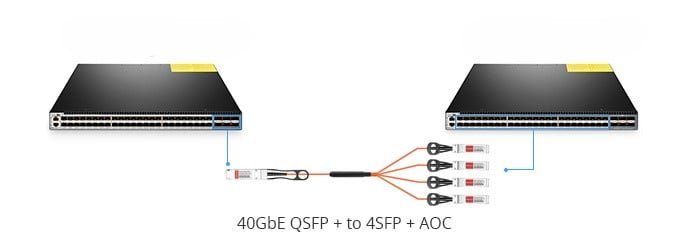
Branching AOC cables offer a cost-effective approach for interconnecting devices within and between adjacent racks. As an example, a 40GbE QSFP+ to four SFP+ port AOC cable can connect a 40G QSFP+ port on one switch to four 10G SFP+ ports on another.
Scenario 3: Extended Distance Transmission
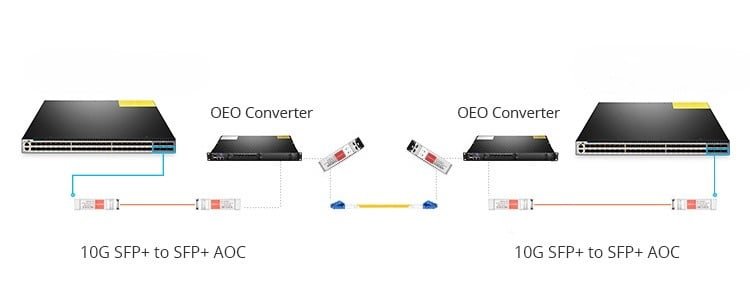
For long-distance inter-switch connections, a solution incorporating single-mode patch cords, Optical-Electrical-Optical (OEO) converters, and AOC cables is recommended. This approach facilitates the seamless integration of dissimilar fiber types by converting multimode fiber to single-mode fiber.
Key Factors To Choose Appropriate AOC Cables
When procuring Active Optical Cables (AOCs), several key factors warrant careful consideration:
Data Rate:
AOC cables facilitate a range of data transmission rates, including 10Gb/s, 25Gb/s, 40Gb/s, 100Gb/s, and 120Gb/s, thereby enhancing connection speeds for storage, data processing, and high-performance computing applications. Data center managers often favor 40G AOC links due to their cost-effectiveness and plug-and-play functionality.
Cable Length
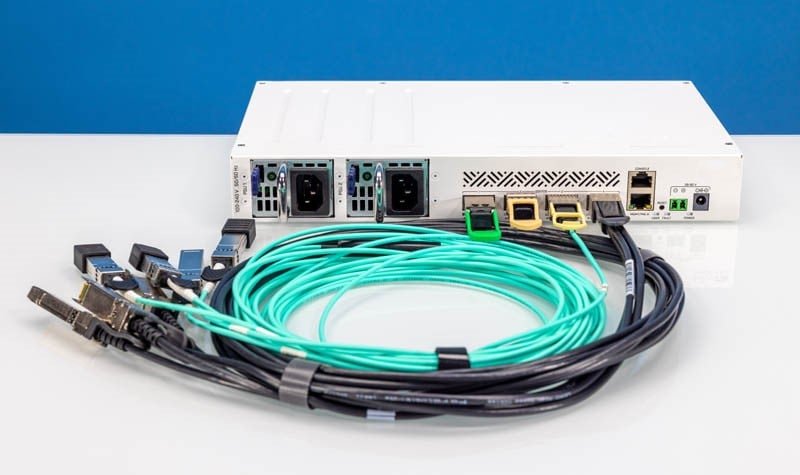
AOCs are designed to mitigate the distance limitations inherent in copper cables. Typically deployed in data centers with link lengths ranging from 1 to 100 meters, selecting the appropriate cable length is crucial for effective cable management. Suboptimal lengths can negatively impact organization and accessibility.
Reliability
As data rates increase, error tolerance diminishes, underscoring the importance of reliability. The integrated electronic components within AOC transceivers present a potential failure point. Consequently, selecting a supplier capable of providing comprehensive test results to validate product reliability is advisable. Fibermart provide 100% compatible and tested aoc cables for your high performance datacenter and networks.
Price and Supplier Selection
While established brands like Cisco, Juniper Networks offer AOCs, their products are often proprietary and expensive. Many IT professionals opt for third-party optical modules as a more economical alternative.
Market Considerations
The AOC market offers a diverse array of options. As data transmission rates continue to rise, power consumption and heat generation become increasingly important considerations. Data center operators focused on reducing carbon emissions and energy costs will find low-power AOC solutions particularly beneficial.
Key Application Areas of Active Optical Cables (AOCs)
Data Centers: AOCs are predominantly utilized in data centers to establish high-bandwidth connections between server racks and rows, with support for protocols including Ethernet, InfiniBand, and Fibre Channel.
High-Definition Audio-Visual and Home Theater Systems: AOCs cater to the demands of gamers and AV professionals, enabling the transmission of high-resolution 8K video and high-fidelity audio from gaming consoles or PCs to display devices over extended distances.
Digital Signage Networks: AOCs facilitate connectivity between media players and displays in expansive environments such as airports, retail centers, and stadiums.
Cloud Computing and High-Performance Computing (HPC): AOCs enable ultra-high-speed communication links between computing clusters and storage infrastructure.
Fibermart AOC Cables Catagory
10G SFP+ AOC Cable
The 10G SFP+ AOC optical cable is a classic solution for 10 Gigabit network interconnection, providing reliable connections from 1 meter to over 100 meters. It integrates SFP+ optical modules at both ends and transmits data via multimode fiber, offering a lighter, more energy-efficient, and electromagnetically interference-free high-performance alternative to copper cables for short-distance interconnections between servers and switches, or between switches. It is widely used in downlink connections for Top-of-Rack (ToR) switches in data centers.
40G QSFP+ AOC Cable
The 40G QSFP+ series AOC (Active Optical Cable) solutions are core solutions designed to meet the diverse high-speed interconnection needs of data centers. This series mainly includes three key types:
40G QSFP+ Breakout AOC splits a single QSFP+ port at one end into four SFP+ ports, enabling the flexible splitting of high-bandwidth ports into multiple independent 10G channels. It is optimized for efficient connection between top-of-rack switches and multiple servers;
Standard 40G QSFP+ AOC provides a complete QSFP+ to QSFP+ direct connection at both ends, using parallel optical technology to achieve stable 40Gbps point-to-point transmission up to 100 meters, making it an ideal backbone link for inter-switch connections or connections with high-performance servers;
40G QSFP+ to LC AOC acts as a bridge for the integration of new and old systems. Its unique design converts the signal from the QSFP+ port into four standard duplex LC interfaces, seamlessly connecting to existing SFP+ fiber optic equipment and cabling infrastructure. This complete product portfolio forms a critical cabling foundation for data centers evolving from 10G to 40G and even higher speeds. By increasing port density, ensuring signal quality, and enabling a smooth transition, it fully empowers the deployment of high-bandwidth, highly flexible, and high-return-on-investment network architectures.
25G/50G SFP56 AOC Cable
The 25G/50G SFP56 AOC optical cable serves the new generation of data centers based on 25G and 50G data rates. SFP56 packaging supports single-channel 25G or 50G speeds, providing a cost-effective single-channel solution for server access and leaf-spine network architectures. It offers higher port density and bandwidth than 10G SFP+, while maintaining similar low power consumption and ease of deployment, making it one of the mainstream choices for cloud data center upgrades.
100G QSFP28 Cable
The 100G QSFP28 AOC is currently the workhorse for 100G interconnects within data centers. It uses QSFP28 packaging and achieves a total bandwidth of 100Gbps through four parallel 25Gbps optical fibers. This cable is widely used for stacking between core switches, interconnecting high-performance computing clusters, and storage networks. Its effective transmission distance covers most scenarios from within a rack to across racks, and it is usually backward compatible with 40G QSFP+ ports.
200G QSFP56 AOC Cable
The 200G QSFP56 AOC represents the next generation of high-speed interconnect technology, achieving 200Gbps aggregate bandwidth within the QSFP package through four 50Gbps channels (PAM4 modulation). It is primarily used in hyperscale data centers and high-performance computing environments to meet the extremely high throughput demands of AI/ML workloads, providing an important transitional or branching solution for the deployment of 400G networks.
400G QSFP-DD OSFP AOC Cable
The 400G AOC (Active Optical Cable) is a core technology for next-generation high-speed interconnects in data centers. It utilizes high-performance packaging such as QSFP-DD or OSFP, achieving a total bandwidth of 400Gbps through 8-channel 50G PAM4 technology. It is specifically designed to address the needs of large-scale AI training, interconnecting core layer switching equipment in hyperscale cloud data centers, and high-performance computing backbone networks. This solution provides unprecedented bandwidth density through a single cable, directly overcoming existing network bottlenecks and serving as critical infrastructure for building faster and flatter data center architectures.
800G OSFP QSFP-DD AOC Cable
The 800G AOC (Active Optical Cable) represents the cutting edge of current optical interconnect technology. It employs advanced packaging such as OSFP or QSFP-DD800, achieving an aggregate bandwidth of 800Gbps through 8-channel 100G PAM4 technology, placing extreme demands on chips, power consumption, and heat dissipation. It is primarily intended for the ultimate internal interconnects of next-generation AI superclusters and top-tier supercomputing centers, connecting the highest-end switching equipment and GPU clusters. This solution provides a clear technological evolution path for the continuous exponential growth of data traffic and is a core interconnect technology supporting future larger-scale and more complex computing power demands.
Conclusion
Active Optical Cables (AOCs) represent a pivotal evolution in high-speed data connectivity, effectively bridging the gap between the distance limitations of copper and the interface simplicity of traditional optics. By integrating transceivers directly into a plug-and-play cable assembly, AOCs deliver the high bandwidth, extended reach, EMI immunity, and physical advantages of fiber optics while maintaining direct compatibility with standard electrical ports.
Their role is increasingly critical in modern data centers, high-performance computing, and advanced AV systems, where demands for speed, density, and reliability are paramount. When compared to DACs or discrete transceiver modules, AOCs offer a compelling balance of performance, manageability, and cost-effectiveness for short to medium-distance links.
As data rates continue to escalate with technologies like 400G and beyond, the importance of efficient, high-fidelity interconnects will only grow. Selecting the appropriate AOC—by considering data rate, length, reliability, and supplier support—is essential for building scalable and resilient infrastructure. At Fibermart, we are committed to providing not only these advanced cabling solutions but also the clarity and guidance needed to implement them effectively, empowering our clients to meet the connectivity challenges of today and tomorrow.
FAQs
How do active optical cables differ from ordinary fiber optic cables?
Active optical cables contain internal chips. These chips convert electrical energy into light energy, and vice versa. Ordinary fiber optic cables do not have these chips. Active optical cables are easier to install and transmit data faster than ordinary fiber optic cables.
Which devices can be connected using active optical cables?
You can use these cables to connect servers, switches, and routers. Televisions and game consoles also support these cables. Most new devices with QSFP, SFP, or HDMI ports support these cables. Be sure to check your device’s manual for compatibility.
What should you check before buying active optical cables?
Check what type of connector your device uses. Determine the required transmission speed and length. Ensure the cable matches your device’s ports. Choose cables with energy-saving features. Check for compliance with standards such as QSFP-DD or SFP-DD.
What problems can active optical cables help you solve?
Active optical cables can help you transmit data quickly. Compared to copper cables, they consume less power and have less signal loss. Active optical cables can be used in situations where copper cables are too bulky or too slow.